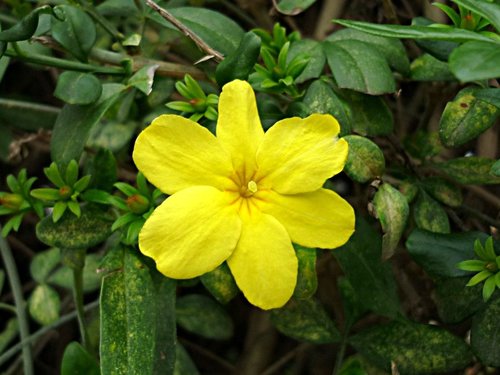
Primrose jasmine
Jasminum mesnyi
The Primrose jasmine is a cascading fountain of gold that announces the arrival of spring. Its arching evergreen branches provide year-round shelter for backyard birds and an essential early feast for the first pollinators of the season.
Quick Identification
Size
Height of 5–10 feet (1.5–3 meters) with a spreading or cascading width of 3–7 feet (1–2 meters).
Colors
Bright lemon-yellow flowers; glossy, deep green foliage; stems are vibrant green when young.
Key Features
- Semi-double yellow flowers with 6-10 petals
- Opposite, trifoliate leaves (three leaflets per leaf)
- Distinctive square-shaped green stems
- Arching or scrambling growth habit without climbing tendrils
When You’ll See Them
Behavior
Primrose jasmine is a robust, evergreen shrub known for its sprawling and fountain-like growth habit. Unlike many other jasmines, it does not climb using tendrils or twining stems; instead, it 'scrambles,' sending out long, arching branches that can form dense thickets or cascade beautifully over garden walls and fences. It is a tough, drought-tolerant species that provides excellent structural cover for small backyard animals throughout the year.
While many jasmines are prized for their scent, the Primrose jasmine is largely unscented. However, it makes up for this with its early blooming schedule. It is often one of the first plants to flower in late winter or very early spring, providing a critical early-season nectar source for emerging pollinators like bumblebees and hoverflies. In the backyard ecosystem, its dense foliage offers a safe nesting site for small birds and a sheltered corridor for ground-dwelling wildlife.
EverydayEarth exclusive
Camera Tips
To capture the best footage of Primrose jasmine, focus your camera on the flowers during the transition from late winter to early spring. Because this plant is a 'pollinator magnet' during a time when few other things are blooming, it is the perfect spot to set up a macro-enabled camera or a close-range trail cam. Position your camera about 2 to 3 feet away from a dense cluster of blooms to catch early-season bees and butterflies in action. Use a high frame rate (60fps) if your camera allows, as this helps clarify the rapid wing movements of visiting insects.
Since Primrose jasmine often grows in arching sprays, use this geometry to your advantage. Angle your camera slightly upward from beneath one of the cascading branches. This perspective not only captures the vibrant yellow of the flowers against the sky but also allows you to see small songbirds that often hop through the inner structure of the bush for protection. If you are using an AI-powered camera like the ones we recommend at EverydayEarth, set your trigger sensitivity to high, as the movement of small pollinators can be subtle.
Time-lapse mode is particularly rewarding with this species. Because the buds open progressively over several weeks, a time-lapse set to take one photo every 30 minutes can document the 'yellow wave' as the shrub transforms from green to gold. For the best lighting, aim for the 'golden hour'—shortly after sunrise or before sunset—when the low-angle light makes the lemon-yellow petals glow and minimizes the harsh shadows often found in the center of dense shrubs.
Similar Species
Species that look similar or are commonly confused with Primrose jasmine.
Frequently Asked Questions
Record Primrose jasmine at your habitat
Connect a camera to start building your own species record — AI identifies every visitor automatically.