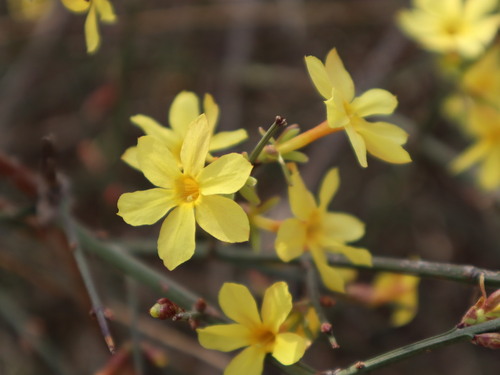
Winter jasmine
Jasminum nudiflorum
The brilliant 'flower that welcomes spring,' winter jasmine brings a burst of sunny yellow to the garden while other plants are still deep in hibernation.
Quick Identification
Size
A mounding or climbing shrub reaching 1.2–3 meters (4–10 feet) in height and spreading up to 4.5 meters (15 feet) wide.
Colors
Bright lemon-yellow flowers; dark green square stems; small, glossy dark green trifoliate leaves that appear after the blooming period.
Key Features
- Bright yellow six-petaled flowers appearing on bare stems
- Distinctive square-shaped green stems that remain green year-round
- Arching, vine-like growth habit that 'weeps' over walls
- Non-fragrant blooms, unlike most other jasmine species
When You’ll See Them
Behavior
Winter jasmine is a resilient, deciduous shrub known for its 'weeping' growth habit. Unlike many of its cousins in the jasmine family, it is a scramble-climber rather than a twining vine, meaning it requires support or a trellis to grow upward. Without support, it forms a dense, mounding groundcover that is excellent for erosion control on slopes. Its most famous trait is its blooming schedule; it produces vibrant flowers in the dead of winter or very early spring when most other flora are dormant.
In the garden, it is often used as a 'harbinger of spring,' signaling the end of the coldest months. While it is native to China, it has become a staple in temperate gardens worldwide due to its hardiness and ability to thrive in poor soil. Interestingly, while it is a true jasmine, it lacks the signature sweet fragrance associated with the genus, trading scent for visual brilliance during the greyest months of the year.
EverydayEarth exclusive
Camera Tips
Capturing winter jasmine on your EverydayEarth camera is a masterclass in patience and timing. Because this plant blooms on bare wood before its leaves appear, the visual contrast between the bright yellow flowers and the deep green stems is striking. To get the best results, set your camera to a time-lapse mode starting in late December. Position the camera on a tripod or stable mount about 2-3 feet away from a cluster of buds. A time-lapse interval of one photo every 2-4 hours will allow you to document the 'awakening' of the shrub as the yellow petals unfurl against the winter frost.
Placement is critical for this species. Because winter jasmine is often planted to spill over stone walls or garden edges, aim your camera at a 45-degree angle downward to capture the 'waterfall' effect of the arching stems. If your camera has a macro setting, use it to capture the unique six-petaled structure of the blossoms. Since the flowers open during the day, ensure your camera is positioned to avoid direct lens flare from the low winter sun, which can wash out the delicate yellow hues. North-facing placement with the sun behind the camera is ideal for saturated colors.
For those interested in the 'AI-powered' aspect of backyard wildlife, keep your camera active during the blooming period to catch early-season pollinators or winter birds. While the plant isn't fragrant, its bright color is a beacon for any insects that emerge on unseasonably warm winter days. Set your motion trigger sensitivity to 'High' to catch these small visitors. In snowy regions, the contrast of the yellow blooms against white snow makes for some of the most spectacular winter garden photography possible—just ensure your camera housing is rated for freezing temperatures.
Similar Species
Species that look similar or are commonly confused with Winter jasmine.
Frequently Asked Questions
Record Winter jasmine at your habitat
Connect a camera to start building your own species record — AI identifies every visitor automatically.