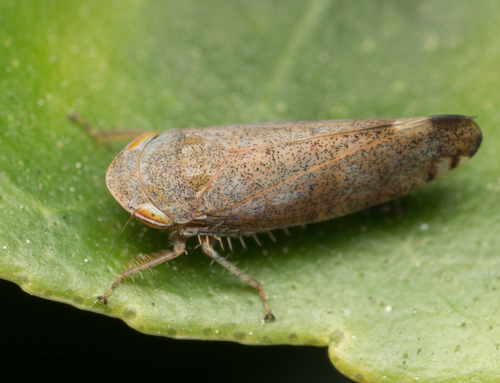
Privet Leafhopper
Fieberiella florii
A master of the garden hedge, the Privet Leafhopper is a miniature marvel covered in delicate black speckles. While small enough to go unnoticed, this agile jumper is one of the most common and fascinating insects to visit suburban ornamental plants.
Quick Identification
Size
6.0-7.5 mm (0.24-0.30 inches) in length
Colors
Pale yellowish-green to ivory base color, densely speckled with fine black or dark brown dots; eyes are often pale with a dark center.
Key Features
- Wedge-shaped body typical of leafhoppers
- Distinctive peppered or speckled black pattern over the entire dorsal surface
- Flattened vertex (top of head) with two small dark spots
- Nymphs are often brighter green with long tail hairs
When You’ll See Them
Behavior
The Privet Leafhopper is a shy and calculated mover. Unlike more frantic insects, it often spends long periods stationary, feeding on the undersides of leaves. When it does move, it exhibits a characteristic 'crab-walk,' shuffling sideways to stay on the opposite side of a stem or leaf vein from a perceived threat. This 'skulking' behavior makes them difficult to spot despite their common presence in suburban hedges.
As a jumping specialist, this species has incredibly powerful hind legs. When startled, it can launch itself many times its body length into the air in a fraction of a second, often disappearing from sight instantly. They are mostly solitary, though you may find dozens living on a single well-maintained privet hedge. While they are primarily known for feeding, they also communicate through substrate-borne vibrations—inaudible to humans—which they use to find mates among the foliage.
EverydayEarth exclusive
Camera Tips
Capturing the Privet Leafhopper requires a specialized macro setup due to its small size and tendency to hide. For backyard AI cameras, the most important factor is focal distance. You need to position your camera extremely close to the foliage—ideally 4 to 8 inches away. Focus your lens on the underside of leaves or the tender new growth of a Privet hedge, as these are the leafhopper's preferred feeding and resting spots.
Because these insects are so light and small, traditional PIR (Passive Infrared) motion sensors may not trigger. To combat this, use a 'Time-Lapse' mode or an AI-powered camera that uses 'Pixel Change' detection. Setting your camera to record in 4K resolution is highly recommended; this allows you to crop into the image later to see the intricate peppered patterns that define the species. If your camera has a high-frame-rate video mode (60fps or higher), use it—this is the only way you will catch the spectacular 'jump' they are named for without it looking like a blur.
Lighting is critical for micro-wildlife. While they are active during the day, the shadows inside a thick hedge can be too dark for a clear shot. Use a small, diffused LED panel to provide fill light, or position your camera on a branch that gets dappled morning sunlight. Avoid direct, harsh midday sun, which can create 'hot spots' on their slightly reflective wings. If you are specifically looking for them, check your host plants for 'stippling'—tiny white or yellow dots on the leaves caused by their feeding—and place your camera right in the center of that activity.
Similar Species
Species that look similar or are commonly confused with Privet Leafhopper.
Frequently Asked Questions
Record Privet Leafhopper at your habitat
Connect a camera to start building your own species record — AI identifies every visitor automatically.