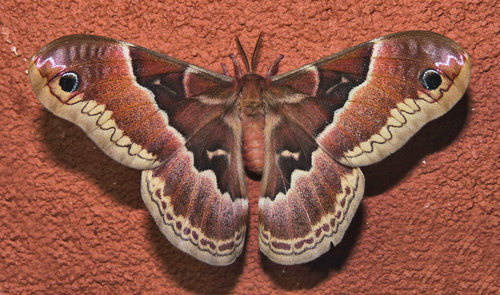
Promethea Silkmoth
Callosamia promethea
Witness the dramatic 'cobra' mimicry and striking sexual dimorphism of the Promethea Silkmoth. One of North America's most beautiful giant silkmoths, these silk-spinners bring a touch of the exotic to eastern deciduous forests.
Quick Identification
Size
Wingspan of 7.6–10.2 cm (3–4 inches)
Colors
Sexual dimorphism: males are charcoal black with tan borders; females are reddish-brown to maroon with tan borders and prominent eye spots.
Key Features
- Distinctive 'cobra-head' eye spots on the tips of the forewings
- Strong sexual dimorphism with black males and brown females
- Characteristic white 'comma' marks in the center of each wing
- Silk-wrapped cocoons that dangle from branches like dead leaves
When You’ll See Them
Behavior
The Promethea Silkmoth is renowned for its unique daily rhythm. Unlike most members of the giant silkmoth family that are strictly nocturnal, Promethea males are active during the afternoon. They can be seen fluttering through the air between 3 PM and sunset, using their large, feathery antennae to track the pheromones of females from miles away. This daytime flight is an evolutionary trick; the black-winged males are thought to mimic the Pipevine Swallowtail butterfly, which is toxic to birds, allowing them to fly safely in daylight.
Females, by contrast, are more traditional saturniids, remaining stationary during the day and becoming active at night to lay eggs. Once the eggs hatch, the caterpillars go through several stages of growth, eventually spinning a remarkably sturdy cocoon. These cocoons are unique because the caterpillar reinforces the leaf stem with silk, ensuring the 'leaf' containing the pupa hangs securely from the tree branch all winter long, even after all other leaves have fallen.
EverydayEarth exclusive
Camera Tips
To capture the Promethea Silkmoth on camera, focus your efforts on 'edge' habitats—areas where a wooded lot meets an open yard or field. These moths prefer the transition zones where host plants like spicebush and sassafras are common. Mount your camera 3 to 5 feet off the ground, pointing toward the sun-dappled foliage of these host plants. Because the males fly during the late afternoon, make sure your camera is positioned to avoid direct lens flare from the setting sun, which can wash out the details of their dark wings.
The most effective 'lure' for a camera setup is a newly emerged female. If you find a dangling cocoon in the winter and keep it in a mesh enclosure until it emerges in late spring, placing that enclosure (with the female inside) near your camera will attract dozens of males. This 'pheromone calling' usually happens in the late afternoon. Set your camera to video mode or a high-speed burst to capture the frantic, erratic flight of the males as they hover around the enclosure.
For those looking to capture the caterpillars or the emergence process, use a macro lens or a camera with a short focal distance. Look for the distinctive cocoons in late winter; they look like curled, dead leaves that refuse to fall from the branch. Setting a time-lapse camera on a cluster of these cocoons in late May can reward you with footage of the spectacular adult moths pulling themselves out of their silk enclosures.
Given their rapid wing beats, a high shutter speed or a frame rate of at least 60fps is recommended for video. This allows you to slow down the footage in post-production, revealing the intricate 'cobra' markings on the wingtips that are often a blur to the naked eye. In suburban settings, keeping your outdoor lights off or using a motion-activated infrared camera is best, as traditional white porch lights can disrupt their natural mating and egg-laying behaviors.
Similar Species
Species that look similar or are commonly confused with Promethea Silkmoth.
Frequently Asked Questions
Record Promethea Silkmoth at your habitat
Connect a camera to start building your own species record — AI identifies every visitor automatically.