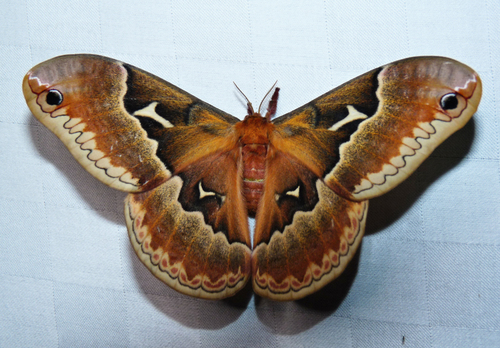
Tulip-tree Silkmoth
Callosamia angulifera
A nocturnal giant of the Eastern forests, the Tulip-tree Silkmoth is a master of camouflage and a spectacular find for any backyard explorer. With its velvety wings and striking angular patterns, it represents the hidden beauty of the night.
Quick Identification
Size
Wingspan of 8–11 cm (3.1–4.3 inches)
Colors
Sexual dimorphism present; males are deep charcoal or dark brown, while females are a lighter reddish-brown or cinnamon color. Both feature distinct yellowish-white angular spots.
Key Features
- Distinctive 'V' or triangular shaped white spots in the center of the wings
- Prominent eyespots near the apical tips of the forewings
- Wavy yellowish or cream-colored border along the wing margins
- Large, feathery antennae, especially broad in males
When You’ll See Them
Behavior
The Tulip-tree Silkmoth is a member of the giant silkmoth family, known for its impressive size and lack of functional mouthparts as an adult. Because they cannot eat, their adult life is fleeting, lasting only about a week, during which their sole purpose is to find a mate and reproduce. They spend their days resting motionless on tree trunks or hidden among foliage, relying on their sophisticated camouflage to avoid predators like birds.
Unlike their close relative, the Promethea moth, which flies during the late afternoon, Tulip-tree Silkmoth males are strictly nocturnal. They use their large, sensitive antennae to detect pheromones released by females from miles away. When they aren't seeking mates, they are frequently drawn to artificial light sources in suburban backyards, where they may be found resting on walls or screens the following morning.
EverydayEarth exclusive
Camera Tips
To capture high-quality images of the Tulip-tree Silkmoth, the most effective strategy is to set up a 'light trap' within view of your camera. Use a white bedsheet hung vertically and illuminate it with a UV (blacklight) or a mercury vapor bulb. Position your AI-powered camera on a tripod approximately 3 to 5 feet away from the sheet, angled slightly upward. This setup mimics the way researchers study moths and will draw the moths directly into your camera's field of view.
Because these moths are large and have a rhythmic, fluttering flight pattern, use a camera setting with a fast trigger speed or, ideally, set it to record short 10-second video clips. The video format is particularly helpful for capturing the iridescent scales and the way the moth vibrates its wings to warm up before flight. If your camera allows for macro adjustments, set the focus for a closer range, as these moths often land and remain still on surfaces for long periods.
Placement is key. If you have a Tulip-tree in your yard, place your camera and light setup near the edge of the tree's canopy. In the southern parts of their range, you may get two 'peaks' of activity—one in late spring and another in mid-summer—so keep your batteries charged during these windows. Avoid high-wind nights, as these heavy-bodied moths prefer to fly when the air is still and humid.
Similar Species
Species that look similar or are commonly confused with Tulip-tree Silkmoth.
Promethea Silkmoth
Males are much darker (almost black) and lack the large angular white spots in the center of the wings.
Polyphemus Moth
Much larger and tan-colored, featuring massive blue and yellow eyespots on the hindwings rather than angular white spots.
Cecropia Moth
The largest moth in North America, it has red body segments and crescent-shaped white marks rather than angular ones.
Frequently Asked Questions
Record Tulip-tree Silkmoth at your habitat
Connect a camera to start building your own species record — AI identifies every visitor automatically.