Puerto Rican Emerald
Riccordia maugaeus
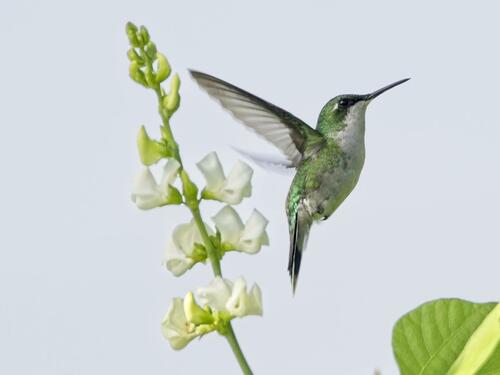
The Puerto Rican Emerald is a living gemstone found only on the 'Island of Enchantment.' This tiny endemic hummingbird dazzles with its metallic green plumage and fearless personality.
Quick Identification
Size
9–10 cm (3.5–4 in) long; wingspan approx. 12 cm (4.7 in); weight 2.8–3.5 g (0.1–0.12 oz)
Colors
Males are iridescent emerald green with a dark, blue-black forked tail. Females are green above and greyish-white below with white-tipped outer tail feathers.
Key Features
- Deeply forked dark tail in males
- Brilliant iridescent green plumage
- Small, slightly decurved black bill
- White spot behind the eye
When You’ll See Them
Geographic range
Where Does the Puerto Rican Emerald Live?
This bird is a Caribbean treasure, found exclusively on the island of Puerto Rico and its neighboring islands of Vieques and Culebra. It is a true endemic, meaning it lives nowhere else in the wild, occupying nearly every ecological niche on the archipelago from sea level to the highest mountain peaks. Whether in the humid rainforests of El Yunque or the dry southern coast, this species is a permanent resident throughout its range.
Basemap © OpenStreetMap contributors
Behavior
The Puerto Rican Emerald is a highly energetic and territorial hummingbird known for its rapid, darting flight. Like many members of its tribe, it practices 'trap-lining,' which involves following a regular route to visit specific flowers throughout the day. They are fiercely protective of their nectar sources and will boldly chase away larger birds or rival hummingbirds that enter their feeding territory.
While they are solitary and do not form flocks, they have adapted remarkably well to human environments. They are a common sight in backyard gardens where they can be observed hovering with precision or performing 'shuttle displays'—side-to-side flights used during courtship or territorial defense. Their high-pitched, metallic chirps are often heard before the bird is actually seen.
EverydayEarth exclusive
Camera Tips
To capture the stunning iridescence of the Puerto Rican Emerald, camera placement is everything. Position your AI-powered camera within 2 to 4 feet of a known nectar source, such as a hummingbird feeder or a cluster of red tubular flowers like Firebush (Hamelia patens). Ensure the sun is behind the camera lens; direct sunlight hitting the bird's feathers is required to trigger the structural coloration that makes them appear emerald green rather than dull black.
Because these birds move with incredible speed, use a camera with a high trigger speed or set your device to 'Sports' or 'Action' mode. If your camera supports video, high frame rate (60fps or higher) is ideal for capturing the blur of their wings, which can beat over 50 times per second. Avoid placing cameras in deep shade, as the sensor may struggle to focus on such a small, fast-moving target in low light.
For the best backyard results, provide a perching twig near your feeder. Puerto Rican Emeralds often sit for a few moments to scan for rivals before and after feeding, providing the perfect opportunity for a still shot. Keeping your feeders clean and filled with a simple 4:1 water-to-sugar ratio will ensure daily visits, especially during the peak breeding season between February and May when they are most active.
Similar Species
Species that look similar or are commonly confused with Puerto Rican Emerald.
Antillean Crested Hummingbird
Look for a prominent pointed crest on the head; the Emerald has a smooth, rounded head.
Green Mango
The Green Mango is significantly larger with a more robust, curved bill and lacks the Emerald's deeply forked tail.
Green-throated Carib
Much larger than the Emerald with a heavy, down-curved bill and distinct blue-green throat patch.
Frequently Asked Questions
Record Puerto Rican Emerald at your habitat
Connect a camera to start building your own species record — AI identifies every visitor automatically.