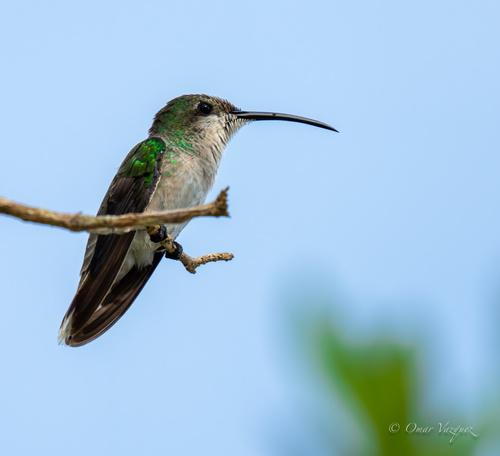
Puerto Rican Mango
Anthracothorax aurulentus
A shimmering emerald of the islands, the Puerto Rican Mango is a bold and beautiful hummingbird famous for its coppery tail and feisty attitude. This Caribbean endemic is a frequent visitor to tropical gardens, bringing a flash of iridescent color to any backyard.
Quick Identification
Size
11–12 cm (4.3–4.7 in) in length; weight 4.8–7.2 g (0.17–0.25 oz)
Colors
Iridescent green upperparts; males have a glittery green throat and velvety brownish-purple belly; females have white underparts with a dark central stripe.
Key Features
- Long, slightly decurved black bill
- Velvety brownish-purple belly patch on males
- Reddish-purple or coppery tail with dark tips
- White-tipped outer tail feathers on females
When You’ll See Them
Geographic range
Where Does the Puerto Rican Mango Live?
Native to the Caribbean, this species is found throughout the Puerto Rican Bank. Its core range includes the main island of Puerto Rico and its offshore islands like Culebra and Vieques, as well as the United States Virgin Islands and the British Virgin Islands. While it is primarily a lowland specialist, it thrives across these tropical landscapes wherever flowering plants and open spaces are available.
Basemap © OpenStreetMap contributors
Behavior
During the day, they balance their time between high-octane foraging and rest. You will often see them 'hawking' for insects, a behavior where they fly out from a perch to snatch tiny gnats or flies from the air before returning to the same spot. They are well-adapted to human environments and are frequent visitors to backyard feeders, often becoming quite habituated to the presence of people if provided with a consistent food source.
EverydayEarth exclusive
Camera Tips
To capture the stunning iridescence of the Puerto Rican Mango, position your AI-powered camera within 18 to 24 inches of a nectar feeder or a high-traffic flowering shrub like Cape Honeysuckle or Hibiscus. Since these birds move with lightning speed, use a high shutter speed setting if your camera allows, and ensure the lens is angled to catch the morning or late afternoon sun. This directional lighting is essential to reveal the deep purples and coppery tail colors that can otherwise look dark or black in the shade.
Mount your camera at chest height (about 4 to 5 feet) to match their typical hovering level at feeders. Because this species is highly territorial, placing a camera near a 'sentinel perch'—usually a bare, exposed twig near a food source—is often more effective than focusing solely on the flowers. They will return to the same twig repeatedly to monitor their territory, providing your camera with the perfect opportunity to capture a clear, stationary image of the bird at rest.
Hummingbirds are naturally attracted to the color red, so using a feeder with red accents or planting red tubular flowers will draw them into the camera's field of view. Keep the camera lens clean and free from nectar residue, as these birds can be messy drinkers. For the best results, place your setup in a spot that is sheltered from high winds to ensure the birds feel stable while hovering in front of your lens.
Similar Species
Species that look similar or are commonly confused with Puerto Rican Mango.
Frequently Asked Questions
Record Puerto Rican Mango at your habitat
Connect a camera to start building your own species record — AI identifies every visitor automatically.