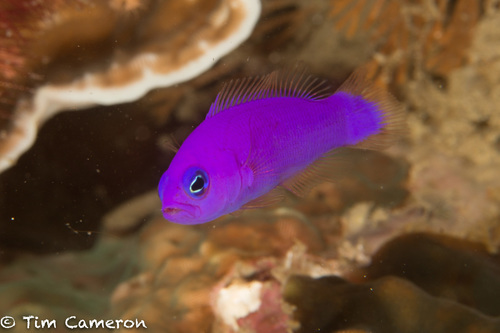
Purple Dottyback
Pictichromis porphyrea
A vibrant splash of magenta in the Pacific reefs, the Purple Dottyback is a tiny powerhouse of color and personality.
Quick Identification
Size
Grows to a maximum length of 6 cm (2.4 inches)
Colors
Brilliant, uniform magenta-purple across the entire body and fins with no secondary markings
Key Features
- Solid, vibrant magenta or electric purple coloration
- Slender, elongated body shape
- Large dark eyes with a thin blue ring
- Lack of any spots, stripes, or facial masks
When You’ll See Them
Geographic range
Where Does the Purple Dottyback Live?
The Purple Dottyback is a jewel of the Western Pacific Ocean, thriving in the warm, tropical waters of the Indo-Pacific region. Its primary range extends from the vibrant reefs of the Philippines and Indonesia eastward to the islands of Samoa. It is also commonly found as far north as the Ryukyu Islands of Japan and stretches south toward the Moluccas and the Admiralty Islands of Papua New Guinea. While they are concentrated in these core coral triangle zones, their presence is noted across various micro-archipelagos throughout the central-western Pacific corridor.
Basemap © OpenStreetMap contributors
Behavior
The Purple Dottyback is a high-spirited and territorial reef inhabitant. Despite its diminutive size, it is known for its remarkable boldness, often defending a specific rocky crevice or coral head against much larger intruders. It is a solitary species that spends the majority of its day darting between hiding spots, rarely venturing far from the safety of the reef structure.
In their natural environment, these fish are incredibly agile, using their slender bodies to navigate tight gaps in the coral. While they are a favorite in the aquarium hobby due to their color, they are quite reclusive when they sense large predators (or divers), instantly retreating into the labyrinth of the reef. Their social structure is mostly competitive, with individuals maintaining strict boundaries against other dottybacks.
EverydayEarth exclusive
Camera Tips
Capturing the Purple Dottyback on an AI-powered underwater camera requires a strategic focus on 'micro-habitats.' These fish are extremely territorial and usually claim a single hole or crevice as their home base. To get the best footage, spend time observing where the fish retreats when startled; once you identify its 'bolt hole,' position your camera on a weighted tripod or sandbag about 12 to 18 inches away, angled slightly upward to catch the fish as it emerges.
Because the Purple Dottyback is so small (only 6 cm), you should use a camera lens with a close focal point or a macro setting if available. Standard wide-angle action cams may make the fish look like a tiny purple blur. Ensure your camera is set to a high frame rate, such as 60fps or higher, because their movements are lightning-fast. They tend to 'twitch' and dart rather than swim smoothly, so high-speed capture is essential to avoid motion blur.
Lighting is the most critical factor for this species. Their magenta color is spectacular but can easily look dark or muddy in deep water or shadows. If possible, deploy your camera in a shallow reef area where natural sunlight can penetrate. If you are using artificial lights, use a wide, diffused video light rather than a direct beam to avoid washing out the delicate purple hues or scaring the fish with a harsh 'hot spot' in the center of the frame.
To encourage the Dottyback to stay in the frame longer, you can use a small amount of 'chum' or frozen brine shrimp tucked into a nearby crevice. However, these fish are naturally curious. Often, simply leaving the camera in place for 20 minutes will allow the fish to become comfortable enough to investigate the lens, providing an intimate, full-frame view of their striking coloration.
Similar Species
Species that look similar or are commonly confused with Purple Dottyback.
Frequently Asked Questions
Record Purple Dottyback at your habitat
Connect a camera to start building your own species record — AI identifies every visitor automatically.