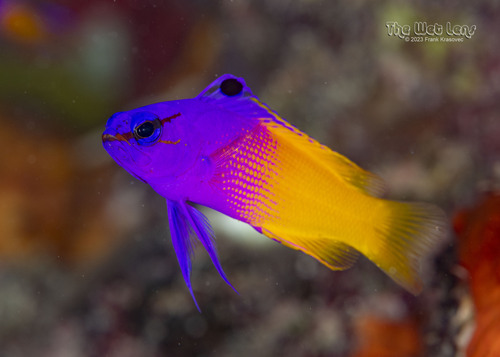
Royal Gramma
Gramma loreto
With its electric purple head and sun-yellow tail, the Royal Gramma is a stunning jewel of the Caribbean reefs. This tiny, cave-dwelling fish is as famous for its vibrant colors as it is for its gravity-defying habit of swimming upside down.
Quick Identification
Size
Up to 8 cm (3 inches) in length; typically weighs less than 10 grams (0.35 oz)
Colors
Bicolor: vibrant royal purple or violet on the front half, transitioning to a bright golden-yellow on the back half
Key Features
- Vivid purple anterior transitioning to a bright yellow posterior
- Distinctive black spot on the front of the dorsal fin
- Narrow dark line running diagonally through the eye
- Propensity for swimming upside down along cave ceilings
- Small, torpedo-shaped body with a squared-off tail
When You’ll See Them
Sightings on EverydayEarth
Jun 4, 2026
A vibrant underwater scene shows several species of small reef fish active around a collection of sea fans and corals. Royal Grammas and Bicolor Damselfish dart in and out of the protective crevices of the reef, while a school of bright Blue Chromis swims in the water column above. The fish are actively foraging and navigating the surge.
Geographic range
Where Does the Royal Gramma Live?
Native to the crystal-clear waters of the tropical Western Atlantic, the Royal Gramma is a signature species of the Caribbean's vibrant reef systems. Its geographic range is centered in the Bahamas and Bermuda, extending south through the Greater and Lesser Antilles. These striking fish are a common sight along the Mesoamerican Barrier Reef, stretching from the Yucatan Peninsula in Mexico down through Belize and Honduras, reaching as far as the northern continental shelf of South America near Venezuela.
Basemap © OpenStreetMap contributors
Behavior
The Royal Gramma is a remarkably peaceful yet territorial reef dweller, famous for its striking appearance and unusual swimming habits. These fish are 'orientation-independent,' meaning they prefer to keep their bellies close to a solid surface regardless of gravity. This often leads to them swimming upside down or sideways along the roofs and walls of underwater caves and overhangs. While they are social and often live in small groups, they are fiercely protective of their individual hiding spots, frequently using a 'gaping' display with their large mouths to ward off intruders.
In the wild, they exhibit a calm temperament and are often seen hovering near their home crevice, occasionally darting out into the open water to snag a meal. They are protogynous hermaphrodites, meaning a group is typically led by a dominant male that was once a female; if the male disappears, the largest female will transition to take his place. They have a largely harmonious relationship with other species and are even known to act as occasional 'cleaners,' removing parasites from larger fish that visit their territory.
EverydayEarth exclusive
Camera Tips
For those capturing the Royal Gramma using underwater or reef-side cameras, the most important factor is 'structure.' These fish are rarely found in open water; instead, position your camera lens to face a vertical rock wall or the entrance of a small, shaded crevice. Because they are shy and retreat into shadows when threatened, a camera with a wide-angle lens placed about 12 to 18 inches from a known hideout will yield the best results without scaring the fish away.
Lighting is your biggest challenge under the sea. Water naturally filters out red and yellow light, which can make the Royal Gramma's vibrant purple look muddy or blue. To capture their true electric colors, use an AI-powered camera with custom white balance settings or a red-tinted filter. If you are using artificial reef lighting, ensure it is set to a full-spectrum 'daylight' mode to highlight the sharp contrast between their purple front and yellow tail.
Royal Grammas move in quick, jerky bursts. To avoid a blurry image, set your camera to a high frame rate—ideally 60 frames per second or higher. This will allow you to freeze the action when they dart out to catch zooplankton. Since these fish are most active when the sun is high and penetrating the water column, schedule your recording or AI detection windows for the middle of the day. Finally, keep your housing clear; in tropical waters, algae and salt deposits can cloud a lens in just a few days, so regular maintenance is essential for crisp, high-definition footage.
Similar Species
Species that look similar or are commonly confused with Royal Gramma.
Frequently Asked Questions
Record Royal Gramma at your habitat
Connect a camera to start building your own species record — AI identifies every visitor automatically.