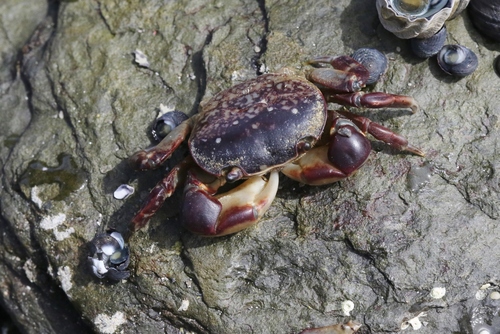
Purple Mottled Shore Crab
Cyclograpsus granulosus
A gem of the Australian rocky shores, the Purple Mottled Shore Crab is a swift and secretive scavenger. Its beautifully patterned, polished shell allows it to blend perfectly into the shadows of the intertidal zone.
Quick Identification
Size
Carapace width 20-40 mm (0.8-1.6 inches); total leg span up to 80 mm (3.1 inches)
Colors
Deep purple, reddish-brown, or grey mottling over a cream or tan base; underside is usually a uniform pale cream
Key Features
- Completely smooth carapace margins without any teeth or notches
- Highly polished and glossy shell texture
- Compact, square-shaped carapace
- Fine hairs present on the walking legs
When You’ll See Them
Geographic range
Where Does the Purple Mottled Shore Crab Live?
Native to the southern coastlines of the Australasian continent, the Purple Mottled Shore Crab is a staple of the Australian intertidal zone. Its core range extends from the central coast of New South Wales, wrapping around the southern shores of Victoria and South Australia, all the way to the southwestern corner of Western Australia. This resilient crustacean is particularly abundant in Tasmania, where it thrives in the cooler, nutrient-rich waters of the Bass Strait.
Basemap © OpenStreetMap contributors
Behavior
The Purple Mottled Shore Crab is a master of the intertidal shadows, spending most of its daylight hours tucked away in damp crevices or beneath heavy stones. Unlike many other crab species that stay submerged, this species is highly adapted to life at the high-tide mark, where it can survive long periods out of the water as long as its gills remain moist. They are exceptionally fast and agile, capable of scurrying sideways into the tightest rock fissures at the slightest vibration or shift in light.
Socially, these crabs are somewhat gregarious, often found in high densities where the rock substrate provides ample protection. However, they are not truly social and will compete for the best hiding spots. When night falls or the tide begins to turn, they emerge from their shelters to forage across the rocks. They are naturally shy around humans, but their sheer speed and erratic movement patterns make them a fascinating subject for patient observers along the shoreline.
EverydayEarth exclusive
Camera Tips
Capturing the Purple Mottled Shore Crab on camera requires a specialized approach because they are much smaller and lower to the ground than typical backyard mammals. To get high-quality footage, place your camera as close to the ground as possible—ideally just an inch or two off the rock surface—and angle it slightly downward toward a flat rock or a known crevice entrance. Using a macro lens or a camera with a short focal distance is essential; a standard trail camera may produce blurry images if the crab is within its minimum focus range.
Lighting is the biggest challenge for this nocturnal species. While many trail cams use infrared (IR) LEDs, the reflective nature of their wet, glossy shells can cause "white-out" or harsh glare. If your camera allows it, use a "Low Glow" or adjustable IR setting. Alternatively, placing a piece of semi-transparent white tape over part of the IR flash can help soften the light, revealing the beautiful mottled patterns on the shell rather than just a white reflection.
To guarantee an appearance, baiting is highly effective. Secure a small mesh bag containing crushed fish scraps, shrimp, or even a bit of oily cat food to a rock using a heavy-duty zip-tie or a weighted clip. The scent will carry through the damp air and tide pools, drawing the crabs out from their deep crevices. Positioning the bait roughly 12-18 inches from the lens usually provides the best frame for both video and stills.
Timing and safety are crucial when setting up near the ocean. Always check the local tide charts before deployment; you want your camera positioned just above the high-water mark to avoid losing equipment to the sea. The best activity usually occurs on a receding tide at night. Set your camera to a high-sensitivity trigger and use "burst mode" for photos, as these crabs move in quick, jerky bursts that can be missed by a slow shutter.
Similar Species
Species that look similar or are commonly confused with Purple Mottled Shore Crab.
Frequently Asked Questions
Record Purple Mottled Shore Crab at your habitat
Connect a camera to start building your own species record — AI identifies every visitor automatically.