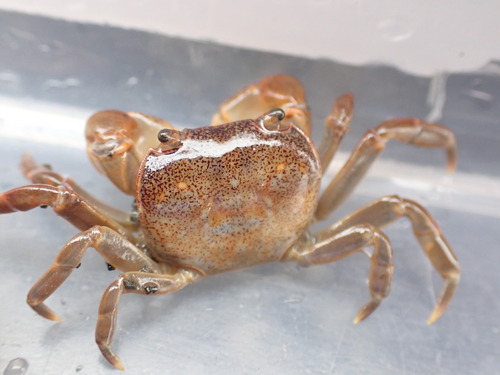
Smooth Shore Crab
Cyclograpsus lavauxi
The Smooth Shore Crab is a master of the intertidal 'splash zone.' With its polished, jewel-like shell and nocturnal lifestyle, it is one of the most successful scavengers of New Zealand's rocky coastlines.
Quick Identification
Size
Carapace width 15–25 mm (0.6–1.0 inches); leg span up to 60 mm (2.4 inches)
Colors
Glossy carapace ranging from slate grey and charcoal to mottled reddish-brown or purple; underside is typically a lighter cream color
Key Features
- Smooth carapace edges with no lateral teeth
- Large, widely spaced eyes
- Polished, porcelain-like shell texture
- Compact, rounded body shape
When You’ll See Them
Geographic range
Where Does the Smooth Shore Crab Live?
Native to the temperate coastal regions of the Southern Hemisphere, the Smooth Shore Crab is found across the entirety of New Zealand's coastline, including the North, South, and Stewart Islands. It also occupies a unique, disjunct population on the Juan Fernández Islands off the coast of Chile. It thrives in the narrow 'splash zone' just above the average high-tide line.
Basemap © OpenStreetMap contributors
Behavior
The Smooth Shore Crab is a resilient inhabitant of the upper intertidal zone, often found huddled together in groups under large, flat stones just above the high-tide mark. Unlike many of its cousins that prefer to stay submerged, this species is highly adapted to life out of the water, relying on moisture trapped beneath rocks to keep its gills damp during the day. They are relatively social, though they will display aggressive 'claws-up' posturing if their specific hiding spot is disturbed by a rival.
As the sun sets and the tide begins to turn, these crabs become much more active. They emerge from their rocky shelters to scavenge along the shoreline. While they are generally shy and will scuttle rapidly toward the nearest crevice when approached by humans, they are bold foragers in the dark, processing large amounts of beach wrack and organic matter that washes up with the waves.
EverydayEarth exclusive
Camera Tips
Capturing the Smooth Shore Crab requires a 'macro' approach because of their small size and specific habitat. Place your camera just a few inches off the ground, ideally mounted on a small tripod or weighted base near the high-tide line. Look for areas with large, flat rocks that show signs of moisture underneath. Aim the lens at the entrance of a crevice or a patch of moist seaweed where the crabs are likely to forage once the sun goes down.
Because these crabs are primarily nocturnal, your camera's infrared (IR) performance is critical. Ensure the IR flash isn't too bright for close-up subjects, as it can 'wash out' the crab's shiny, reflective shell. If your camera allows, dial down the flash intensity or use a diffuser. A high-resolution sensor is beneficial here to capture the subtle textures and colors of the carapace that distinguish it from other shore crabs.
Salt spray is your biggest enemy when filming near the ocean. Use a protective housing and check the lens regularly for salt crusting, which will blur your images. Positioning the camera slightly behind a rock or driftwood can provide a natural windbreak and protection from the elements. For the best action shots, time your camera deployment for the hour following high tide during the night, when the crabs are most active in the damp debris left behind by the receding water.
Similar Species
Species that look similar or are commonly confused with Smooth Shore Crab.
Frequently Asked Questions
Record Smooth Shore Crab at your habitat
Connect a camera to start building your own species record — AI identifies every visitor automatically.