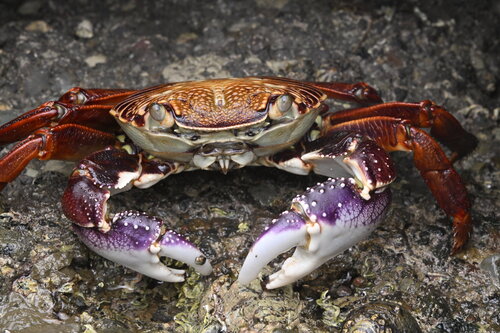
Purple Rock Crab
Leptograpsus variegatus
The ultimate coastal acrobat, the Purple Rock Crab brings a flash of royal color to the world's most rugged shorelines. Watch them sprint across vertical cliffs and navigate the treacherous splash zone with unmatched speed.
Quick Identification
Size
Carapace (shell) width 50–80 mm (2–3.2 in); total leg span can reach up to 200 mm (7.8 in).
Colors
Typically vibrant purple or bluish-purple, often mottled with yellow, white, or cream spots; younger individuals may appear more grey or olive-green.
Key Features
- Broad, square-shaped carapace with fine transverse ridges
- Striking purple coloration with yellow highlights on the joints
- Large, prominent eyes set wide apart for 360-degree awareness
- Extremely fast, flattened legs built for rapid sideways scurrying
When You’ll See Them
Geographic range
Where Does the Purple Rock Crab Live?
This species is a staple of the southern subtropical Indo-Pacific. It is most commonly found along the rugged coastlines of Australia and New Zealand, but its range extends across the Pacific to include Easter Island and the western coast of South America, particularly Chile and Peru. It thrives in high-energy environments where the ocean meets the rock, making it a frequent sight for coastal hikers across the Southern Hemisphere.
Basemap © OpenStreetMap contributors
Behavior
The Purple Rock Crab is often called the 'swift-footed crab,' and for good reason. It is one of the most agile crustaceans in the intertidal zone, capable of sprinting across vertical rock faces and jumping across gaps between tide pools to escape predators or crashing waves. They are highly visual creatures; their large eyes can detect movement from many meters away, causing them to retreat into deep rock crevices at the first sign of danger.
While they spend much of their time out of the water, they are bound to the sea. They frequently dip into tide pools or allow sea spray to wash over them to keep their gills moist, which is essential for their breathing. They are generally solitary and can be quite territorial, often raising their claws in a defensive 'threat display' if another crab or a curious human gets too close to their preferred foraging patch.
EverydayEarth exclusive
Camera Tips
Setting up a camera for the Purple Rock Crab requires a specialized approach because of their harsh, salty environment. You should use an action camera with a waterproof housing or a trail camera specifically rated for coastal conditions. Position the camera at a low angle, roughly 12-18 inches off the ground, pointed toward a flat 'sunnning' rock or a cluster of barnacles where the crabs are likely to forage. Use a heavy-duty tripod or a clamp mount to ensure the camera isn't swept away by a rogue wave.
Because these crabs are triggered by movement, standard PIR sensors on trail cameras might be set off by moving seaweed or waves. If your camera allows, set a 'time-lapse' mode during low tide hours or use a high-sensitivity motion setting but mask out the areas of the frame where the ocean is visible. The best footage is often captured just as the tide is receding, as the crabs emerge from their hiding spots to feed on freshly uncovered nutrients.
To attract them into the frame, you can use a 'bait cage'—a small mesh bag filled with crushed mollusks or oily fish scraps—secured firmly to a rock with stainless steel wire. This prevents the bait from washing away and encourages the crabs to stay in front of the lens for longer periods. Remember to clean your lens daily with a microfiber cloth and fresh water, as salt crystals will quickly accumulate and ruin the clarity of your shots.
Similar Species
Species that look similar or are commonly confused with Purple Rock Crab.
Frequently Asked Questions
Record Purple Rock Crab at your habitat
Connect a camera to start building your own species record — AI identifies every visitor automatically.