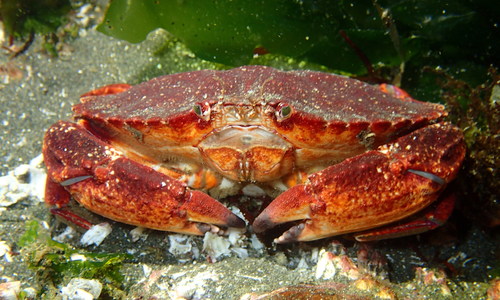
Red Rock Crab
Cancer productus
Nicknamed the 'Pearl of the Pacific Northwest,' the Red Rock Crab is a crimson-colored powerhouse of the West Coast tide pools. With its massive black-tipped claws and armor-like shell, it is one of the most formidable and fascinating invertebrates for coastal explorers to discover.
Quick Identification
Size
Carapace width typically 12–18 cm (5–7 in), with exceptionally large males reaching 20 cm (8 in); weight ranges from 0.5–1.5 kg (1–3 lbs).
Colors
Adults are a deep, uniform brick red to dark purple; juveniles are highly variable, ranging from stark white to intricate striped or mottled patterns of grey and tan.
Key Features
- Massive, heavy pincers with distinctive black tips
- Carapace has 10 wide, scalloped 'teeth' on each side of the eyes
- The front of the shell (between the eyes) has five nearly equal-sized teeth
When You’ll See Them
Geographic range
Where Does the Red Rock Crab Live?
Native to the eastern Pacific coastline of North America, the Red Rock Crab is a staple of the West Coast's marine ecosystem. Its range stretches from the Aleutian Islands in Alaska down through the rugged coasts of British Columbia, Washington, and Oregon, continuing through California to the northern reaches of Baja California, Mexico. They are most densely populated in the cool, nutrient-rich waters of the Pacific Northwest, where they are a common sight for beachcombers and divers alike.
Basemap © OpenStreetMap contributors
Behavior
The Red Rock Crab is known as the 'tough guy' of the Pacific intertidal zone. Unlike many other crab species that scuttle away when threatened, these crabs are notoriously aggressive and will often stand their ground, raising their massive black-tipped claws in a defensive posture. They are powerful predators, capable of using their exceptionally strong pincers to crush the shells of barnacles, snails, and even other crabs.
While they can be active during the day, especially in deeper water, they are primarily crepuscular or nocturnal in the intertidal zone. They use the cover of high tide to move into the shallows to forage, then tuck themselves tightly into rocky crevices or under kelp canopies as the tide recedes. They are generally solitary and can be highly territorial over choice hiding spots in the rocks.
EverydayEarth exclusive
Camera Tips
Capturing the Red Rock Crab requires a different approach than typical backyard wildlife. Since these are marine creatures, you will need a waterproof action camera or an underwater housing for your trail cam. The best placement is inside a large, deep tide pool that doesn't completely dry out at low tide. Secure your camera to a heavy diving weight or a flat rock using stainless steel bolts or heavy-duty zip ties to ensure the surging Pacific surf doesn't wash your equipment away.
To guarantee a 'visit' from a Red Rock Crab, use a scent lure. Crabs have an incredible sense of smell and will travel surprisingly long distances for a meal. Place a small mesh bag filled with smashed mussels, sea urchin, or a piece of oily fish (like salmon or herring) directly in front of the camera lens, about 12-18 inches away. The crab's attempts to pick at the bait through the mesh will result in excellent close-up footage of their dexterity and powerful claw movements.
Lighting is your biggest challenge underwater. If your camera doesn't have a built-in light, try to set up your 'stage' in a shallow pool during the day when natural sunlight can penetrate the water. However, for the most dramatic footage, use an external waterproof LED. These crabs are most active at night; seeing a deep red crab emerge from the shadows of a kelp forest into the light of your camera is a spectacular sight. Set your camera to record short video clips (15-30 seconds) to capture their unique 'sideways' gait and social interactions.
Similar Species
Species that look similar or are commonly confused with Red Rock Crab.
Dungeness Crab
Dungeness crabs have white-tipped claws and a lighter tan/brown shell, while Red Rock crabs have black-tipped claws and a brick-red shell.
Pacific Rock Crab
Also known as the Brown Rock Crab, it has more spots on the legs and a lighter brownish-red color compared to the uniform deep red of C. productus.
Frequently Asked Questions
Record Red Rock Crab at your habitat
Connect a camera to start building your own species record — AI identifies every visitor automatically.