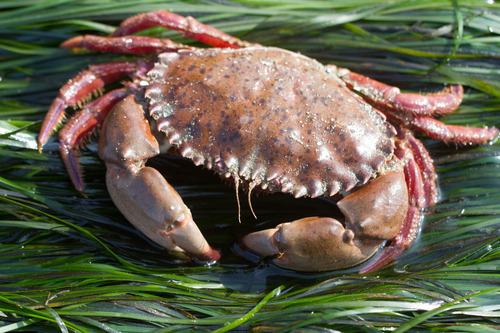
Pacific Rock Crab
Romaleon antennarium
The heavy-hitter of the West Coast tide pools, the Pacific Rock Crab is a powerful predator recognizable by its brick-red shell and black-tipped pincers.
Quick Identification
Size
Carapace width ranges from 12-18 cm (5-7 inches); weights typically reach 0.5-1 kg (1.1-2.2 lbs)
Colors
Deep brick red to brownish-purple carapace; underside is cream-colored with distinct red spotting; claws are tipped in black
Key Features
- Powerful claws with black tips
- Creamy underside heavily spotted with red
- Wide, fan-shaped shell with a granulated texture
- Walking legs covered in stiff, dark hairs
When You’ll See Them
Geographic range
Where Does the Pacific Rock Crab Live?
Native to the eastern Pacific Ocean, the Pacific Rock Crab is a hallmark species of the North American West Coast. Its range spans from the southern reaches of British Columbia, Canada, down through the coastal waters of Washington, Oregon, and California, terminating in central Baja California, Mexico. This species is particularly abundant in the temperate rocky reefs of Central and Northern California, where they thrive in both shallow tide pools and deeper offshore kelp forests.
Basemap © OpenStreetMap contributors
Behavior
The Pacific Rock Crab is a formidable predator and scavenger of the West Coast's rocky reefs. Primarily nocturnal, these crabs spend their daylight hours squeezed into tight rock crevices or partially buried in sand near the base of reefs to avoid predators like sea otters and octopuses. When the sun sets or the tide rushes in, they emerge to forage, using their sensitive antennae to detect chemical cues from potential prey in the water.
Known for their aggressive temperament and incredible crushing power, they are solitary creatures that do not hesitate to defend their territory. While they are generally shy around humans in the water, they are a common sight for pier fishers and tide-poolers. They play a vital role in the marine ecosystem by cleaning up carrion and controlling the populations of various mollusks and smaller invertebrates.
EverydayEarth exclusive
Camera Tips
To capture the Pacific Rock Crab on camera, you will need a waterproof action camera or a trail camera equipped with a specialized underwater housing. For those with 'backyard' access to the coast, the best placement is within a stable tide pool during low tide. Secure the camera to a weighted base or wedge a tripod firmly between heavy rocks; the incoming tide creates significant surge that can easily sweep away unsecured equipment.
Baiting is highly effective for this species. Place a small mesh bag filled with crushed sardines, mackerel, or squid about 12 to 18 inches in front of the lens. The oily scent will draw crabs out from their hiding spots even in low visibility. Ensure the bait bag is tied down securely, or the crab may attempt to drag the entire setup back into its crevice!
Since these crabs are most active after dark, use a camera with high-quality infrared (IR) night vision. Set your device to record short video clips (20-30 seconds) rather than still photos, as this allows you to observe their fascinating 'shredding' feeding behavior and social interactions. If the water is clear, time-lapse photography during the incoming tide can also yield spectacular results as the crabs emerge from the sand and rocks.
Similar Species
Species that look similar or are commonly confused with Pacific Rock Crab.
Dungeness Crab
Larger with white-tipped claws and a lighter, brownish-purple shell compared to the rock crab's black tips and deep red color.
Red Rock Crab
Very similar but lacks the red spots on the underside (ventral surface) that are characteristic of the Pacific Rock Crab.
Yellow Rock Crab
Features a lighter, more yellowish-brown shell and lacks the heavy hair on the legs seen on the Pacific Rock Crab.
Frequently Asked Questions
Record Pacific Rock Crab at your habitat
Connect a camera to start building your own species record — AI identifies every visitor automatically.