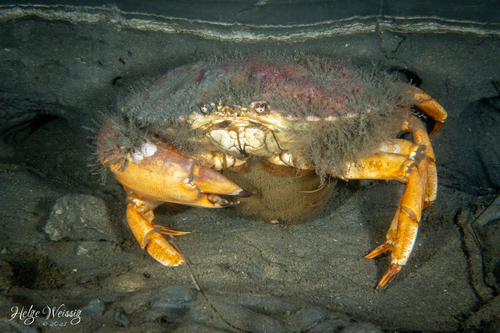
Yellow Rock Crab
Metacarcinus anthonyi
A golden-hued master of the Pacific shallows, the Yellow Rock Crab is a robust scavenger famous for its powerful black-tipped claws and secretive nighttime habits. It is a quintessential resident of California's bays and piers.
Quick Identification
Size
Carapace width ranges from 10 to 18 cm (4 to 7 inches); weight typically between 0.2 to 0.7 kg (0.5 to 1.5 lbs)
Colors
Uniformly pale yellow to brownish-orange on the upper shell, with a cream-colored underside; claws are distinguished by prominent black tips
Key Features
- Broad, oval-shaped carapace with roughly 9-10 blunt teeth along the front edge
- Large, robust pincers with distinct black tips
- Uniform yellowish-brown coloration without spotting
- Prefers sandy or muddy bottoms over rocky crevices
When You’ll See Them
Geographic range
Where Does the Yellow Rock Crab Live?
The Yellow Rock Crab is native to the Pacific coast of North America, where it thrives in the temperate waters of the Eastern Pacific. Its core range extends from Humboldt Bay in Northern California down through the coastal waters of Southern California and into the Baja California peninsula in Mexico. While they are most densely populated in the warmer waters of the Southern California Bight, they are a staple resident of the entire Californian coastline.
Basemap © OpenStreetMap contributors
Behavior
The Yellow Rock Crab is a fascinating scavenger and predator that plays a vital role in the Pacific coastal ecosystem. Unlike some of its more aggressive relatives, this species is somewhat more reclusive, often spending its daylight hours partially buried in sandy or muddy substrates to avoid predators like sea otters, sharks, and large rays. They are primarily nocturnal, emerging as the sun sets to forage along the seafloor and around man-made structures like pier pilings and rock jetties.
In social terms, they are largely solitary and can be territorial when food sources are scarce. When confronted by a threat, they typically fold their legs inward and rely on their thick carapace for protection, though they won't hesitate to use their powerful claws if provoked. For coastal residents, they are a common sight around docks and shallow bays, where they are often seen scuttling sideways with surprising speed across the sediment.
EverydayEarth exclusive
Camera Tips
Capturing the Yellow Rock Crab on camera requires a specialized approach since they are primarily aquatic. For coastal backyard enthusiasts with dock access, the best strategy is to use a waterproof 'drop-cam' or an action camera in an underwater housing suspended about 12 to 24 inches above the seabed. Aim the camera at a flat, sandy patch near a structure like a pier piling, as crabs use these supports for protection and navigation.
To ensure a successful 'sighting,' use a perforated bait container (like a small mesh bag or a PVC tube with holes) filled with oily fish such as sardines, mackerel, or even chicken necks. Secure the bait directly in the camera's field of view. The scent will travel through the water column and draw crabs from several meters away. Because they are nocturnal, you will need a camera equipped with high-quality infrared (IR) LEDs to capture clear grayscale footage without using bright white lights that might startle other marine life or attract unwanted attention.
If you are setting up in a tide pool during low tide, position your camera at a low angle, almost level with the pool floor, to get an intimate view of their movement. Look for 'corridors' between rocks where the crab might travel. Set your camera to record short video clips (15-30 seconds) rather than still photos, as the way these crabs use their mouthparts and claws to sift through sand is much more interesting to watch in motion. Check the tide tables and time your deployments for the two hours leading up to high tide, when crabs are most active in the shallows.
Similar Species
Species that look similar or are commonly confused with Yellow Rock Crab.
Red Rock Crab
Deep red color compared to the yellow/brown of the Yellow Rock Crab, and prefers rocky crevices over sandy bottoms.
Dungeness Crab
Larger in size with white-tipped claws, whereas the Yellow Rock Crab always has distinct black tips on its pincers.
Pacific Rock Crab
Also known as the Brown Rock Crab, it has a more mottled, reddish-brown pattern compared to the uniform yellow of M. anthonyi.
Frequently Asked Questions
Record Yellow Rock Crab at your habitat
Connect a camera to start building your own species record — AI identifies every visitor automatically.