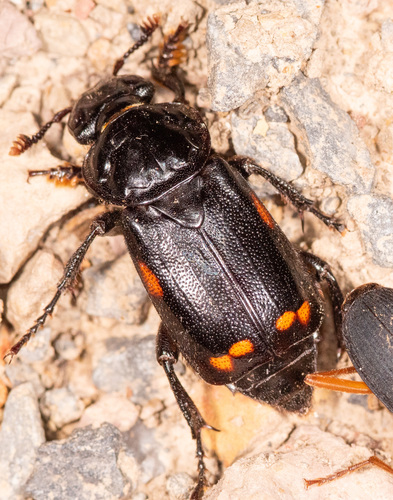
Pustulated Carrion Beetle
Nicrophorus pustulatus
A striking nocturnal 'gravedigger' with a hidden life, the Pustulated Carrion Beetle is famous for its bright orange spots and its unique role as a specialist hunter of snake eggs.
Quick Identification
Size
12–25 mm (0.5–1.0 inches) in length
Colors
Shiny jet-black body with four prominent orange-to-reddish scalloped spots (pustules) on the wing covers (elytra); antennae have orange-tipped clubs
Key Features
- Four distinct orange-red spots on shiny black wing covers
- Large, orange-tipped clubbed antennae
- Broad, flat black pronotum (thorax)
- Thick, powerful legs built for digging
When You’ll See Them
Geographic range
Where Does the Pustulated Carrion Beetle Live?
This beetle is native to North America, spanning a vast territory across the eastern and central regions. Its range begins in southern Canada, particularly Ontario and Quebec, and stretches down through the eastern United States to the Gulf Coast, reaching as far west as the edge of the Great Plains in states like Nebraska and Texas. Because they rely on specific snake nesting habitats, they are most abundant in moist, wooded environments where their hosts are frequently found.
Basemap © OpenStreetMap contributors
Behavior
These beetles are primarily nocturnal and are exceptionally strong fliers. They use sensitive chemical receptors in their antennae to detect the scent of decomposition or specific host nesting sites from miles away. When not breeding, they act as nature's clean-up crew, feeding on carrion and the larvae of competing flies. They are often seen by humans because they are strongly attracted to artificial lights at night.
EverydayEarth exclusive
Camera Tips
Since these beetles are jet-black and highly reflective, infrared (IR) flashes on trail cameras can sometimes cause 'white-out' or overexposure on the beetle's body. If your camera has adjustable flash settings, set it to 'Low' or use a 'No-Glow' model to preserve the detail of the orange wing spots. If your camera has a macro mode or a close-focus lens, this is the time to use it, as these beetles are relatively small subjects.
The best time to set your camera is during warm, humid summer nights when the air is still, as this is when their scent-tracking is most effective. Look for locations near rotting logs or stone walls where snakes might nest. You can also take advantage of their attraction to light by placing a camera near a porch light or a white sheet illuminated by a UV lamp (a common moth-trapping technique), which often brings these beetles right to you.
Similar Species
Species that look similar or are commonly confused with Pustulated Carrion Beetle.
Frequently Asked Questions
Record Pustulated Carrion Beetle at your habitat
Connect a camera to start building your own species record — AI identifies every visitor automatically.