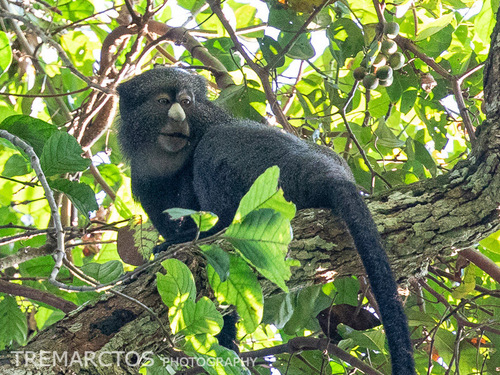
Putty-nosed Monkey
Cercopithecus nictitans
Recognizable by the striking white 'putty' spot on its nose, this agile guenon is a master of the African canopy. From its complex vocal language to its acrobatic leaps, the Putty-nosed Monkey is a fascinating glimpse into the world of social primates.
Quick Identification
Size
Head-body length: 43–70 cm (17–28 in); Tail length: 65–100 cm (26–39 in); Weight: 3–7 kg (6.6–15.4 lbs)
Colors
Dark olive-green to greyish-black speckled coat with a distinctive, bright white heart-shaped spot on the bridge of the nose. Limbs and tail are usually darker, often blackish.
Key Features
- Large heart-shaped white spot on the nose
- Speckled olive-dark fur
- Very long, dark, non-prehensile tail
- Slender, athletic build with long limbs
When You’ll See Them
Behavior
Putty-nosed Monkeys are highly social and intelligent primates that typically live in troops led by a single dominant male and several females with their young. They are renowned among primatologists for their complex vocal communication system. They use specific call sequences, such as combining 'pyows' and 'hacks,' to convey detailed information about predator types and the need to move the group to a safer location.
These monkeys are masters of the canopy and are rarely seen on the ground. They are famous for forming 'polyspecific associations,' which means they actively seek out and travel with other monkey species, like Diana monkeys or Red-tailed monkeys. This behavior increases the number of eyes searching for predators like leopards or eagles, allowing the Putty-nosed Monkey to forage with greater security. While they are naturally wary of humans, they can become quite bold in areas where they are protected from hunting.
EverydayEarth exclusive
Camera Tips
Capturing the Putty-nosed Monkey on an AI-powered camera requires a shift in perspective—you must look up. Because they are almost exclusively arboreal, ground-level sets are unlikely to capture anything more than a passing glimpse. The most successful placements are high in the canopy, between 15 and 30 feet. Look for 'arboreal highways,' which are stable, horizontal branches that connect different tree crowns. Secure your camera to a thick trunk overlooking these crossing points, as the monkeys will pause briefly before leaping, giving your camera time to trigger.
Food is the best motivator for these primates. If you have access to a fruiting tree—especially wild figs, oil palms, or native berries—focus your efforts there. Position the camera about 5 to 10 feet away from a cluster of fruit, angling it slightly downward to capture the monkeys as they sit and forage. In drier areas or during the peak of the dry season, a camera aimed at a secluded, elevated water source or a tree-hole reservoir can produce spectacular results as the troop visits to drink in the mid-afternoon heat.
Technical settings are critical because these monkeys are incredibly fast. Use the highest possible shutter speed and a trigger interval of 'zero' or 'rapid-fire' to ensure you catch the action. Their dark fur can often be 'lost' against the shadows of the forest, so if your camera allows, bump the exposure compensation up slightly (+0.5 or +1.0) or ensure the area is well-lit by morning sun. Early morning light is particularly effective at highlighting the signature white nose spot, which is the key diagnostic feature for your AI to identify the species.
Finally, durability is key. Putty-nosed Monkeys are curious and may attempt to pull at or bite your camera equipment. Use a heavy-duty security box and camouflage it with local moss or bark to make it less conspicuous. Avoid using bright-colored straps; instead, use steel cables or dull-colored paracord. If you are using a lure, such as a salt lick or small amounts of local fruit, place it on a wide limb directly in the center of the frame to keep the troop in the detection zone for as long as possible.
Similar Species
Species that look similar or are commonly confused with Putty-nosed Monkey.
Lesser Spot-nosed Monkey
Smaller in size with a white fur collar around the neck and a less prominent, more oval nose spot.
Red-tailed Monkey
Identified by its bright chestnut-red tail and distinctive white cheek patches, though it also has a white nose spot.
Blue Monkey
Part of the same species group but lacks the white nose spot and has a more uniform, dark-greyish coat.
Frequently Asked Questions
Record Putty-nosed Monkey at your habitat
Connect a camera to start building your own species record — AI identifies every visitor automatically.