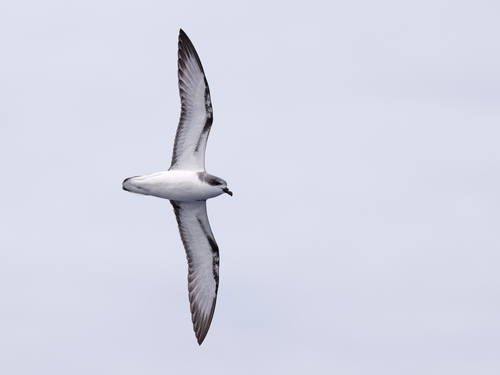
Pycroft's Petrel
Pterodroma pycrofti
A ghostly voyager of the South Pacific, Pycroft’s Petrel is a rare seabird that navigates by the stars. Returning to secret island burrows only under the cover of darkness, this elusive species is a true marvel of the nocturnal world.
Quick Identification
Size
Length: 26 cm (10 in); Wingspan: 55–60 cm (21.5–23.5 in); Weight: 160 g (5.6 oz)
Colors
Pale grey upperparts with a faint dark 'M' pattern across wings; snowy white underparts and forehead; dark smudge around the eyes.
Key Features
- Faint dark 'M' pattern across upper wings
- Distinct dark patch through the eye
- Small, black, hooked bill
- Pure white underwings with thin dark trailing edge
When You’ll See Them
Behavior
Pycroft's Petrels are remarkable 'gadfly' petrels, named for their erratic, high-arching flight patterns over the open ocean. They spend the majority of their lives far from land, navigating the subtropical waters of the Pacific. They are highly pelagic, meaning they only return to terrestrial environments during the breeding season, and even then, they are strictly nocturnal on land to avoid the prying eyes of predatory gulls and skuas.
On their breeding islands, these birds are surprisingly social and vocal. After dusk, the air fills with their distinct 'ti-ti-ti' calls as they wheel over the forest canopy before dropping down to their burrows. They are excellent excavators, using their bills and feet to dig long tunnels in soft soil or under the roots of coastal trees. Within these hidden chambers, pairs share the duties of incubating a single egg and raising their chick.
EverydayEarth exclusive
Camera Tips
Capturing a Pycroft's Petrel on camera is a specialized task because they are only found on specific offshore islands in New Zealand during their breeding season. To successfully film them, you must place your camera near the entrance of an active burrow. Look for signs of 'fresh' work, such as cleared dirt or the presence of the bird’s distinctive musky scent. Position the camera very low—roughly 10 to 15 inches off the ground—and angle it slightly upward to capture the bird as it lands or emerges from the tunnel.
Because these birds are strictly nocturnal and highly sensitive to light, it is mandatory to use a camera with 'No-Glow' or 'Black' infrared LEDs. Standard red-glow infrared can startle the birds and potentially disrupt their breeding behavior. Set your camera to a high-sensitivity trigger with a short delay, as these petrels can be quite fast and erratic when landing through the tree canopy. Using a 'Photo + Video' mode is ideal, as it allows you to capture a still image for identification and a video to record their unique vocalizations and social interactions.
Avoid using any form of bait or lures, as this can attract non-target species or predators that threaten the colony. The best results occur on overcast nights with little moon, which is when petrels are most active on the ground. Ensure your camera is securely tethered to a stake or heavy root, as the coastal winds and the birds' own clumsy landings can easily knock a loose camera out of alignment. If your camera supports AI detection, utilize 'Small Animal' or 'Bird' settings to help filter out the movement of wind-blown ferns and forest debris.
Similar Species
Species that look similar or are commonly confused with Pycroft's Petrel.
Frequently Asked Questions
Record Pycroft's Petrel at your habitat
Connect a camera to start building your own species record — AI identifies every visitor automatically.