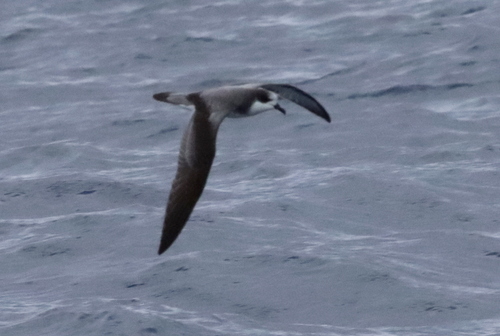
Stejneger's Petrel
Pterodroma longirostris
A phantom of the high seas, Stejneger's Petrel is a master of the Pacific winds. Known for its striking wing patterns and secretive island life, this rare traveler is a testament to the wonders of the open ocean.
Quick Identification
Size
Length: 26–30 cm (10–12 in); Wingspan: 60–66 cm (24–26 in); Weight: 130–180 g (4.6–6.3 oz)
Colors
Slate-grey upperparts with a dark 'M' pattern; white underparts and underwings; white forehead with a dark crown/eye patch
Key Features
- Distinct dark 'M' pattern across wings and back
- White forehead and throat contrasting with a dark cap
- Small, delicate black bill
- Long, narrow wings designed for high-arching flight
When You’ll See Them
Behavior
On their breeding grounds in the Juan Fernandez Islands, these birds transition from solitary ocean-dwellers to social, nocturnal nesters. They arrive at their colonies after dark to avoid aerial predators, creating an atmospheric soundscape of calls and whistles as they navigate to their underground burrows. Their interaction with humans is historically limited due to their remote nesting sites, though they are currently a focus of intense conservation efforts to protect them from invasive species.
EverydayEarth exclusive
Camera Tips
Since these petrels are strictly nocturnal when on land, using a camera with 'No-Glow' or high-quality infrared (IR) night vision is non-negotiable. Standard white flashes will disorient the birds and potentially attract predators to the burrow site. Ensure your camera’s trigger speed is set to its fastest possible setting (0.2 seconds or less). These birds move with incredible speed when landing to minimize their exposure time on the surface.
Avoid using any food-based lures, as these can attract invasive rodents or feral cats which are the primary threat to this species. Instead, focus on placement near natural landmarks. Elevated ridges where the birds catch updrafts to take flight are excellent spots for capturing high-action takeoff photos. If you are using a camera in these tropical, high-altitude environments, use high-capacity lithium batteries, as the high humidity and cool night temperatures can significantly reduce the lifespan of standard alkaline batteries.
During the peak months of December and January, set your camera to burst mode. This increases your chances of getting a clear shot of the bird's identifying 'M' pattern on its wings as it fans them out during a landing or takeoff sequence. If you are monitoring from a vessel at sea, use a gimbal-stabilized mount to counteract the ocean's swell, and target the 'chum line' behind the boat, though Stejneger's are more likely to be seen at a distance than right at the stern.
Similar Species
Species that look similar or are commonly confused with Stejneger's Petrel.
Cook's Petrel
Slightly paler head with less contrast between the crown and the forehead; different underwing markings.
Pycroft's Petrel
Smaller overall size and a shorter, more delicate bill than the Stejneger's.
Gould's Petrel
Has a much darker, sootier head and more extensive dark markings on the underwing.
Frequently Asked Questions
Record Stejneger's Petrel at your habitat
Connect a camera to start building your own species record — AI identifies every visitor automatically.