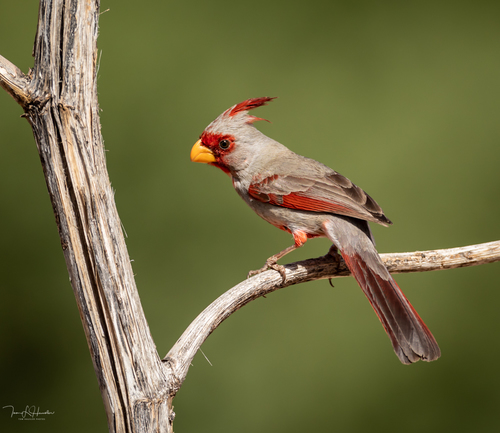
Pyrrhuloxia
Cardinalis sinuatus
Meet the 'Desert Cardinal,' a master of arid survival with a parrot-like beak and striking crimson highlights. A must-see for any backyard birder in the Southwest, the Pyrrhuloxia is a subtle beauty that brings a touch of the wild desert to your camera lens.
Quick Identification
Size
Length: 8.3 in (21 cm) | Wingspan: 12 in (30 cm) | Weight: 0.8–1.5 oz (24–43 g)
Colors
Muted gray-brown overall; males feature a bright red face mask, crest, and breast stripe; females are mostly gray with subtle red tints on the crest and wings; both sexes have a distinct yellow beak.
Key Features
- Short, stout, parrot-like yellow beak
- Tall, slender crest that is often held upright
- Grayish-brown body plumage with crimson accents
- Medium-sized songbird with a long tail
When You’ll See Them
Behavior
The Pyrrhuloxia, often called the desert cardinal, is a resilient songbird known for its ability to thrive in the harsh, arid environments of the American Southwest. Unlike their more boisterous Northern Cardinal cousins, Pyrrhuloxias tend to be somewhat shy and elusive, often sticking to the cover of dense mesquite or thorny scrub. During the breeding season, they are strictly territorial, but in the winter months, they can become quite social, forming large foraging flocks that may include other desert-dwelling species.
These birds are primarily ground foragers but will readily visit elevated bird feeders if they feel secure. Their vocalizations are similar to the Northern Cardinal but thinner and more metallic in tone. When interacting with humans, they are cautious observers; they will often perch at the top of a cactus or shrub to survey an area before descending to feed, making them an excellent subject for patient backyard observers and AI camera enthusiasts.
EverydayEarth exclusive
Camera Tips
To capture the best footage of a Pyrrhuloxia, place your camera approximately 3 to 4 feet off the ground, ideally aimed at a low-profile platform feeder or a natural perch like a mesquite branch. These birds are ground-foragers by nature, so they are more likely to visit a station that feels accessible and close to cover. If you are using a trail camera in a wilder part of your property, look for 'washes' or areas with dense thorny vegetation where they naturally congregate for protection.
Water is the absolute best lure for this species in the desert heat. A dripping birdbath or a small fountain with the sound of moving water will attract Pyrrhuloxias from a distance. Position your camera to face the water source from the north or south to avoid the harsh glare of the desert sun, which can wash out the subtle red and gray tones of their plumage. If you use a feeder, black oil sunflower seeds and cracked corn are their favorites; the AI camera will easily recognize their unique profile as they crack the shells with their heavy yellow beaks.
Because the Pyrrhuloxia is a quick-moving bird that often flicks its tail and crest, set your camera to a high-speed trigger or 'Burst Mode.' This ensures you capture the moment the crest is fully extended, which is their most iconic pose. During the hot summer months, the hours just after sunrise and just before sunset are golden; the soft light at these times makes the male's red chest pop beautifully against their gray bodies. In winter, keep your camera active all day, as they may visit in small groups to forage together during the cooler hours.
Similar Species
Species that look similar or are commonly confused with Pyrrhuloxia.
Northern Cardinal
The Northern Cardinal has a bright red beak and the male is fully red, whereas the Pyrrhuloxia has a yellow beak and a mostly gray body.
Phainopepla
While also crested and desert-dwelling, the Phainopepla is smaller and either solid black (male) or solid gray (female) with no red markings or thick yellow beak.
Frequently Asked Questions
Record Pyrrhuloxia at your habitat
Connect a camera to start building your own species record — AI identifies every visitor automatically.