Northern Cardinal
Cardinalis cardinalis
With its brilliant red plumage and soulful song, the Northern Cardinal is the undisputed king of the backyard. A year-round visitor across much of North America, this striking bird brings a burst of color to every season.
Quick Identification
Size
Length: 21–23 cm (8.3–9.1 in); Wingspan: 25–31 cm (9.8–12.2 in); Weight: 42–48 g (1.5–1.7 oz)
Colors
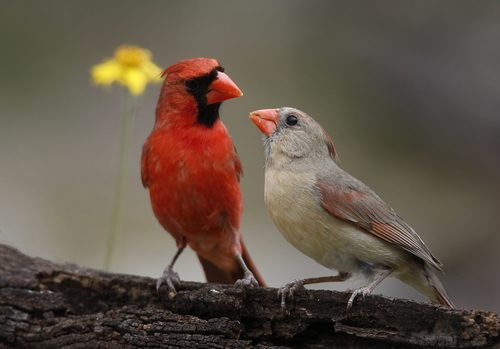
Males are a brilliant crimson red with a jet-black face mask. Females are a warm fawn or grayish-tan with subtle red highlights on the wings, tail, and crest, and a lighter grayish face mask.
Key Features
- Prominent pointed head crest
- Conical, stout coral-colored bill
- Long, rounded tail
- Black facial mask encircling the bill and eyes
When You’ll See Them
Sightings on EverydayEarth
Feb 12, 2026
A male Northern Cardinal perches on the rim of the bird feeder tray. It remains vigilant, looking around the backyard before dipping its head into the tray to feed on mealworms and seeds.
May 17, 2026
A pair of Northern Cardinals—a bright red male and a buff-brown female—are busy feeding on sunflower seeds. They use their strong, conical beaks to crack open the shells right in front of the camera lens, appearing comfortable feeding in close proximity to one another.
May 11, 2026
A male Northern Cardinal perches on the side of the feeder tray. He looks around cautiously before dipping his head to forage through the sunflower and corn seeds.
May 3, 2026
A vibrant male Northern Cardinal perches briefly on the edge of the seed tray, displaying its sharp crest and black facial mask, before taking flight.
Apr 2, 2026
A male Northern Cardinal and an American Goldfinch share the feeder tray. The cardinal perches on the left, occasionally turning its head to look at the camera, while the smaller goldfinch stays on the right side, busy selecting and husking seeds.
Aug 1, 2026
A male Northern Cardinal is perched on the lower right edge of the wooden feeder tray. He remains relatively still, looking around at the seeds on the tray as the light fades during dusk.
Behavior
Northern Cardinals are charismatic and highly social birds that are often the first to arrive at feeders in the morning and the last to leave in the evening. Unlike many other songbirds, both males and females sing throughout the year, often using melodic whistles to defend territory or communicate with a mate. They are monogamous and can often be seen in pairs, with the male occasionally feeding the female as part of a courtship ritual known as mate-feeding.
While they are territorial during the nesting season, cardinals are generally tolerant of humans and thrive in suburban environments. They spend a significant amount of time hopping through low shrubs or foraging on the ground for fallen seeds. Because they do not migrate, they become a staple of the backyard landscape even in the dead of winter, providing a vibrant splash of color against the snow and remaining loyal to the same neighborhood for years.
EverydayEarth exclusive
Camera Tips
To capture the perfect shot of a Northern Cardinal, position your camera at a height of 3 to 5 feet, targeting a flat tray feeder or a low, sturdy branch near a shrub line. Since cardinals are ground-foragers by nature, they are more likely to visit cameras focused on lower elevations or 'platform' style setups rather than small, hanging tube feeders. Use a fast shutter speed or a high-sensitivity motion trigger, as their movements can be quick and jerky when they are alert for predators.
For the best lighting, face your camera North or South to avoid the harsh glare of the rising or setting sun, which is when cardinals are most active. This is particularly important for capturing the true vibrance of the male's red plumage without washing it out. If your camera allows for burst mode, enable it; cardinals often perform a 'look-around' behavior after landing, giving you several frames to find the one where the crest is fully raised and the bird is in sharp profile.
Attracting them to your camera's field of view is easiest with black oil sunflower seeds or safflower seeds, which are their absolute favorites. In the winter, cardinals are less shy and will frequent cameras consistently, especially if you provide a fresh water source or a heated birdbath nearby. The contrast of the red feathers against a snowy background makes for spectacular high-contrast photography that really showcases the bird’s features. Ensure your camera lens is clean, as the cardinal's frequent 'wing-flicking' can sometimes kick up dust near ground-level setups.
Similar Species
Species that look similar or are commonly confused with Northern Cardinal.
Pyrrhuloxia
Found in the Southwest, it has a similar crest but is mostly gray with red accents and has a curved, parrot-like yellow bill.
Summer Tanager
The male is entirely red but lacks a crest and the black facial mask of the cardinal.
Cedar Waxwing
Has a similar head crest but is sleek brown and yellow with a black 'bandit' mask and no red on the body.
Frequently Asked Questions
Record Northern Cardinal at your habitat
Connect a camera to start building your own species record — AI identifies every visitor automatically.