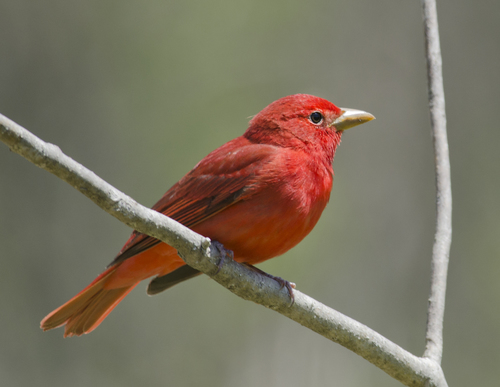
Summer Tanager
Piranga rubra
The Summer Tanager is a flash of brilliant strawberry-red among the green leaves of the forest canopy. A master of the air, this 'bee-eating' specialist is one of the most vibrant visitors to the American backyard.
Quick Identification
Size
Length: 17 cm (6.7 in) | Wingspan: 28-30 cm (11-12 in) | Weight: 30 g (1.1 oz)
Colors
Adult males are a brilliant, solid strawberry-red year-round. Females and immature birds are mustard-yellow to olive-green, occasionally showing orange patches as they mature.
Key Features
- Solid rose-red plumage on males with no black mask
- Thick, pale, blunt-tipped bill
- Absence of a head crest
- Distinctive 'picky-tuck-tuck' call note
When You’ll See Them
Behavior
Summer Tanagers are renowned as bee and wasp specialists. They are fascinating to watch as they 'sally' from high perches to snatch stinging insects right out of the air. Once they’ve caught a bee, they will carry it back to a branch and beat it against the wood to remove the stinger before consuming it. This unique foraging strategy allows them to thrive in areas where other birds might avoid the local insect life.
While they are quite social during migration and on their wintering grounds, they are fairly territorial during the summer breeding season. They generally stay high in the forest canopy, making them more often heard than seen. Their song is a series of sweet, whistling notes similar to an American Robin, but with a slightly huskier, more hurried delivery.
EverydayEarth exclusive
Camera Tips
To capture the elusive Summer Tanager on camera, you must entice them down from the high canopy. The single most effective lure is moving water. These birds are highly attracted to the sound of a dripper, bubbler, or mister in a birdbath. Place your camera about 3 to 5 feet away from the water source at a slight downward angle. Ensure the camera is positioned to catch the light from the side rather than from behind, which prevents the male's intense red feathers from looking like a dark silhouette.
During the spring migration (late April to May), you can boost your chances by offering high-energy foods. While they aren't typical seed-eaters, they will frequently visit cameras baited with suet, halved oranges, or even grape jelly. If you use a feeder, try to place it near the edge of a wooded area where the birds feel safe enough to venture out from the foliage. A 'perch-and-shoot' setup—where you place a natural branch a few feet from the feeder—will give the bird a place to land first, resulting in much more natural-looking photos.
For camera settings, prioritize a high shutter speed. Summer Tanagers are quick, nervous movers when they are close to the ground. If your AI camera has a 'burst mode' or 'video' setting, use it to capture the moment they sally out to grab a bug. Because the red of the male is so saturated, try to set your camera's exposure slightly lower (-0.3 or -0.7 EV) to preserve the detail in their feathers; otherwise, the bright red can 'bleed' in digital images and lose its texture.
Similar Species
Species that look similar or are commonly confused with Summer Tanager.
Scarlet Tanager
The male Scarlet Tanager has jet-black wings and a black tail, whereas the Summer Tanager is entirely red.
Northern Cardinal
Cardinals have a prominent head crest and a black mask around a bright orange-red bill.
Hepatic Tanager
Found in the West, the Hepatic Tanager has a darker, grayish bill and gray wash on its cheeks.
Frequently Asked Questions
Record Summer Tanager at your habitat
Connect a camera to start building your own species record — AI identifies every visitor automatically.