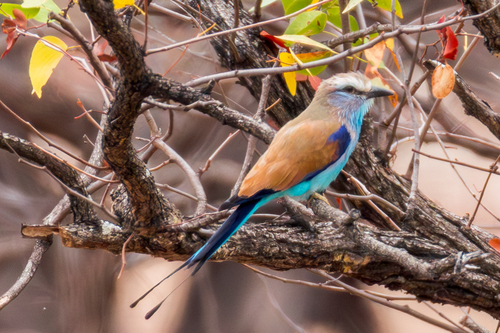
Racket-tailed Roller
Coracias spatulatus
With its stunning lilac breast and elegant 'racket' tail streamers, this elusive woodland specialist is one of Africa's most beautiful avian treasures. Often found in the high canopy of Miombo forests, it is a master of acrobatic flight and a prize for any wildlife photographer.
Quick Identification
Size
28–30 cm (11–12 in) body length, plus 8 cm (3 in) tail streamers; weight 88–108g (3.1–3.8 oz)
Colors
Pale blue head and underparts, lilac throat and breast, cinnamon-brown back, and vibrant violet-blue wings. Distinctive long outer tail feathers ending in black spatulate 'rackets'.
Key Features
- Elongated outer tail feathers ending in black 'rackets'
- Rich lilac-colored throat and upper breast
- Azure and violet-blue wing patches visible in flight
- Large, heavy black bill with a slight hook
When You’ll See Them
Geographic range
Where Does the Racket-tailed Roller Live?
The Racket-tailed Roller is a signature species of the southern African subtropics, primarily found within the expansive Miombo woodland belt. Its range stretches from the Atlantic coast of Angola across to the Indian Ocean shores of Mozambique, covering significant portions of Zimbabwe, Zambia, Malawi, and southeastern DR Congo. It also reaches into northern Botswana and the Caprivi Strip of Namibia, following the distribution of mature broadleaved forests.
Basemap © OpenStreetMap contributors
Behavior
The Racket-tailed Roller is a master of the air, known for its spectacular 'rolling' courtship displays where it dives and tumbles through the sky while emitting harsh, raucous calls. Unlike some of its more urban-adapted relatives, this species is somewhat shy and prefers the interior of undisturbed woodlands. It is a sit-and-wait predator, often spending long periods motionless on a high branch before darting down to snatch prey from the ground or mid-air.
These birds are generally solitary or found in pairs, though small family groups may be seen after the breeding season. They are highly territorial and will aggressively defend their nesting sites, which are typically unlined cavities in high tree trunks, often reclaimed from woodpeckers or barbets. While they are not common in bustling suburban backyards, they are frequent visitors to gardens that border protected broadleaved woodlands or farm-style properties with mature indigenous trees.
EverydayEarth exclusive
Camera Tips
To capture a Racket-tailed Roller on camera, placement is everything. Unlike the Lilac-breasted Roller which often sits on low roadside wires, the Racket-tailed variety prefers higher perches within the woodland canopy. Position your camera on a tripod or mount it 3–5 meters high on a tree trunk, angled toward a prominent, dead 'lookout' branch. These birds return to the same vantage points repeatedly to scan for insects on the forest floor.
Because they are wary of human activity, using a high-resolution, motion-activated trail camera with a fast trigger speed is essential. Their flight is rapid and erratic, so if your camera has a 'burst' or 'photo+video' mode, enable it to ensure you catch the moment they dive for prey. Since they are attracted to the activity of other insects, placing a camera near a known termite mound or a recently burned patch of ground (where they hunt fleeing insects) can yield incredible results.
In drier regions, a shallow birdbath placed in a quiet, shaded area of a woodland garden can be a magnet. They are particularly active during the early morning 'golden hour.' Ensure your camera is facing away from the rising sun to avoid lens flare on their iridescent blue feathers. If you are using an AI-powered camera, set it to prioritize 'Birds' and look for the distinctive silhouette of the tail streamers to confirm a positive ID.
Similar Species
Species that look similar or are commonly confused with Racket-tailed Roller.
Frequently Asked Questions
Record Racket-tailed Roller at your habitat
Connect a camera to start building your own species record — AI identifies every visitor automatically.