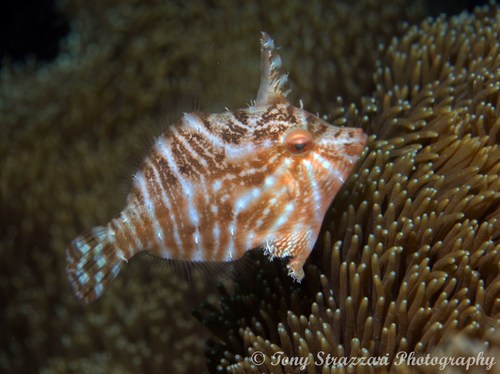
Radial Leatherjacket
Acreichthys radiatus
A master of disguise, the Radial Leatherjacket is a tiny reef dweller that perfectly mimics the soft corals it calls home. With its striking radiating eye patterns and gentle movements, it is one of the Pacific's most fascinating 'hidden' gems.
Quick Identification
Size
A small species reaching a maximum length of approximately 7 centimeters (2.8 inches)
Colors
Tan to light brown base with distinctive white radiating lines stemming from the eye; often displays a complex pattern of blotches for camouflage
Key Features
- Radiating white lines extending from the eye across the head
- First dorsal spine is strong and can be locked into an upright position
- Skin has a rough, sandpaper-like texture (leather-like)
- Body is deep and compressed with a small, upturned mouth
When You’ll See Them
Geographic range
Where Does the Radial Leatherjacket Live?
The Radial Leatherjacket is a jewel of the tropical Western Pacific. It is natively found in a broad arc stretching from the Ryukyu Islands of southern Japan through the biodiversity-rich waters of the Philippines and the eastern reaches of Indonesia. Its southern range extends to the northeastern coast of Australia—particularly the Great Barrier Reef—and out toward the coral reefs of Papua New Guinea and New Caledonia.
Basemap © OpenStreetMap contributors
Behavior
The Radial Leatherjacket is a shy, solitary species that relies heavily on its remarkable ability to blend into its surroundings. It is often found living in close association with soft corals, particularly those of the genus Xenia, which it mimics in both color and texture. This crypsis allows it to hide from larger predators while remaining relatively stationary for long periods.
During the day, they are active foragers, slowly picking through the reef. They are not strong swimmers and prefer to use their dorsal and anal fins for precise, delicate movements rather than rapid flight. While generally docile, they can be territorial around their preferred coral hideouts. In the presence of humans or divers, they typically retreat into the reef or flatten themselves against a coral branch to remain undetected.
EverydayEarth exclusive
Camera Tips
Capturing the Radial Leatherjacket requires a specialized approach due to its tiny size and incredible camouflage. Since these fish are often found nestled within soft corals like Xenia or among seagrasses, your underwater camera should be positioned just 12 to 24 inches from the host organism. Use a macro lens or a close-up filter if possible, as a standard wide-angle action cam might lose the fish against the complex background of the reef.
Because the Radial Leatherjacket relies on 'crypsis' (blending in), traditional motion detection can be tricky. The swaying of corals often triggers false positives. For the best results, use an AI-powered camera configured to recognize distinct shapes or movement patterns within a specific focal zone. Alternatively, set a short interval time-lapse during the middle of the day—typically between 10 AM and 3 PM—when the sun provides the best natural lighting for the shallow reef flats where they reside.
While bait isn't usually recommended for this shy species, placing your camera near its preferred food source—soft coral polyps—is the most effective 'lure.' Ensure your camera is securely weighted or mounted to a stable rock (avoiding live coral) to prevent surge from blurring your shots. If you are using artificial lights for evening shots, use a red filter or low-intensity setting; these fish are easily spooked by sudden, bright white flashes.
Similar Species
Species that look similar or are commonly confused with Radial Leatherjacket.
Frequently Asked Questions
Record Radial Leatherjacket at your habitat
Connect a camera to start building your own species record — AI identifies every visitor automatically.