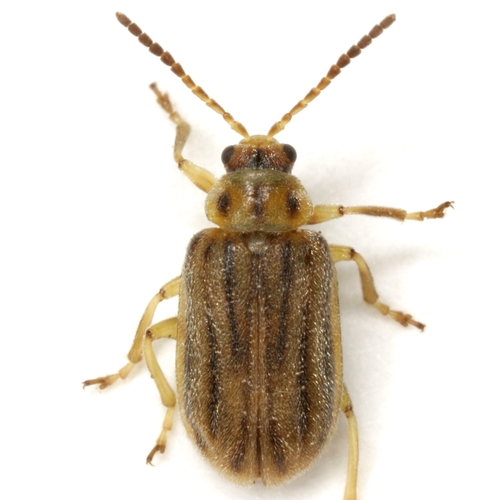
ragweed leaf beetle
Ophraella communa
The ragweed leaf beetle is a tiny, striped powerhouse that spends its days munching on one of nature's most annoying allergens. This specialist herbivore is a fascinating example of how specific insects can shape an entire backyard ecosystem.
Quick Identification
Size
3.5–5.0 mm (0.14–0.20 inches) in length
Colors
Dull yellow to brownish-tan base color with three to four dark brown longitudinal stripes on each wing cover (elytra).
Key Features
- Small oval-shaped body
- Distinctive dark brown longitudinal stripes
- Large, prominent black eyes
- Antennae approximately half the length of the body
When You’ll See Them
Behavior
The ragweed leaf beetle is a highly specialized herbivore that spends its entire life cycle tied to its host plant. Both the larvae and the adults are voracious feeders, often found on the undersides of leaves where they are protected from direct sunlight and predators. They move with a slow, deliberate crawl, rarely flying unless they need to locate a new patch of ragweed once their current food source is depleted.
These beetles are social only in the sense that they aggregate where food is plentiful. During the breeding season, you can often find dozens of individuals on a single plant. For humans, they are considered beneficial insects because they specifically target ragweed, a major source of hay fever. By consuming the leaves and flowers, they significantly reduce the plant's ability to produce the pollen that causes seasonal allergies.
EverydayEarth exclusive
Camera Tips
Capturing the ragweed leaf beetle requires a specialized macro setup because of their diminutive size. Standard trail cameras will likely miss them or produce blurry images. Use a camera with a macro lens or a high-quality smartphone with a macro attachment. Position your lens within 3 to 5 inches of a ragweed leaf that shows signs of 'window-panning'—this is the characteristic feeding damage where the beetle eats the green tissue but leaves the clear membrane behind.
For the best results, look for ragweed patches in full sun. These beetles are cold-blooded and most active when the sun is high and the temperature is warm. Mount your camera on a small flexible tripod (like a GorillaPod) wrapped around the ragweed stem itself. This ensures that if the plant moves in the breeze, your camera moves with it, keeping the beetle in focus. Aim for a side-profile shot to capture the distinct stripes on their elytra.
Because these insects don't move particularly fast, you don't need a high shutter speed, but you do need good lighting. If the plant is in the shade, use a small LED fill light to bring out the golden-brown hues of their shell. If your camera has a 'focus peaking' feature, use it to ensure the beetle's eyes or stripes are the sharpest part of the image.
Consider using the time-lapse mode on your camera. Set it to take a photo every 60 seconds over a two-hour period during a sunny afternoon. This will often capture interesting behaviors like mating, egg-laying, or the rhythmic way they 'mow' through a leaf. It is much more effective than relying on a motion sensor, which may not be sensitive enough to trigger for such a small creature.
Similar Species
Species that look similar or are commonly confused with ragweed leaf beetle.
Frequently Asked Questions
Record ragweed leaf beetle at your habitat
Connect a camera to start building your own species record — AI identifies every visitor automatically.