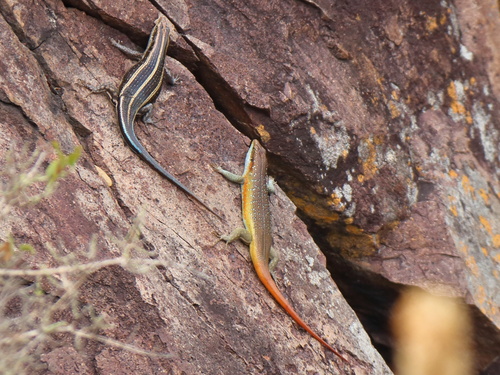
Rainbow Skink
Trachylepis margaritifer
With its shimmering metallic scales and an electric-blue tail, the Rainbow Skink is a living jewel of the African backyard. These sun-loving speedsters are the perfect subject for patient wildlife photographers and backyard observers alike.
Quick Identification
Size
Total length 18–25 cm (7–10 inches); Snout-vent length (SVL) is typically around 10 cm (4 inches).
Colors
Juveniles and females are dark brown to black with three yellow longitudinal stripes and a vibrant electric-blue tail; adult males develop orange or yellowish flanks and a brownish-grey back.
Key Features
- Electric-blue tail in juveniles and females
- Three distinct pale yellow stripes running from head to tail
- Smooth, glossy scales with a metallic sheen
- Stout, cylindrical body with well-developed limbs
When You’ll See Them
Sightings on EverydayEarth
Jun 29, 2026
A Rainbow Skink is basking on the sunny, rocky bank of the Olifants River. It occasionally shifts its position and turns its head, displaying flashes of blue on its tail against the reddish soil.
Jun 27, 2026
A Rainbow Skink is perched on a sun-dappled rock, basking in the light. It remains mostly stationary, likely absorbing heat from the stone surface and the sun, with its long, vibrant blue tail draped across the rock face.
Geographic range
Where Does the Rainbow Skink Live?
The Rainbow Skink is native to the sun-drenched landscapes of Southern and Eastern Africa. Its core range spans across South Africa, Zimbabwe, Botswana, and Mozambique, extending northward into Malawi, Zambia, and Tanzania. This species is a specialist of the African 'kopje' (rocky hill) systems but has successfully colonized man-made structures throughout its range.
Basemap © OpenStreetMap contributors
Behavior
The Rainbow Skink is a bold and conspicuous reptile, frequently seen basking in the open during the hottest parts of the day. They are heliothermic, meaning they rely on direct sunlight to regulate their body temperature, and can often be found perched atop rocky outcrops or stone garden walls. These lizards are highly territorial; dominant males will aggressively defend prime basking spots, often bobbing their heads or displaying their brightly colored flanks to intimidate rivals.
In suburban environments, they have become remarkably habituated to human activity. They are agile hunters and surprisingly fast, capable of darting into the smallest rock crevices or under foliage at the first sign of danger. While they are generally solitary, several individuals may inhabit the same large rock pile or garden bed if food and basking spots are plentiful.
EverydayEarth exclusive
Camera Tips
To capture the Rainbow Skink on camera, placement is everything. These lizards are 'thigmotactic,' meaning they love contact with surfaces, and they are strictly diurnal. Position your camera just 6 to 12 inches off the ground, targeting a flat, sun-exposed rock or a stone garden wall. Because they are cold-blooded, they will spend long periods in these specific spots every morning to warm up, providing the perfect opportunity for a still shot or video.
Because skinks are small and move with lightning speed, your camera settings need to be optimized for action. Set your PIR (motion) sensitivity to 'High' and ensure your trigger speed is at its fastest setting—ideally 0.3 seconds or less. If your camera has a 'close-focus' or macro lens feature, use it; otherwise, place the camera at least 3 feet away to ensure the skink remains in focus while still being large enough in the frame to see its vibrant colors.
You can encourage 'camera-friendly' behavior by creating a 'lizard lounge' in front of your lens. Stack several flat pieces of slate or local stone to create crevices and basking platforms. Clearing away tall grass or obstructing twigs directly in front of the lens will prevent false triggers and ensure a clear view of the skink's brilliant blue tail. A small, shallow water dish placed nearby can also act as a natural lure, especially during the dry summer months.
Similar Species
Species that look similar or are commonly confused with Rainbow Skink.
Frequently Asked Questions
Record Rainbow Skink at your habitat
Connect a camera to start building your own species record — AI identifies every visitor automatically.