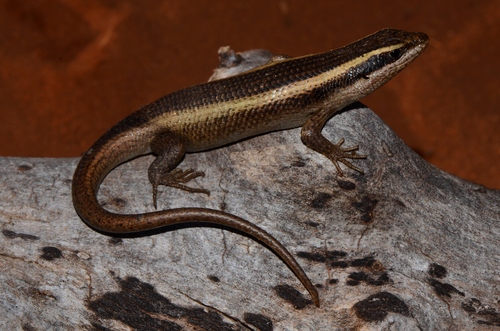
African Striped Skink
Trachylepis striata
The African Striped Skink is a glistening, sun-loving neighbor frequently found patrolling garden walls and rocky outcrops. Known for its bold personality and striking gold-toned stripes, this resilient lizard is a master of the backyard safari.
Quick Identification
Size
Total length of 15-25 cm (6-10 inches), with the tail often making up more than half the length; weight typically 20-40 grams.
Colors
Bronze to dark brown body with two prominent yellowish or cream-colored stripes running from the head to the base of the tail; belly is pale white or light grey.
Key Features
- Two distinct pale longitudinal stripes on a bronze back
- Smooth, highly reflective scales
- Long, tapering tail
- Robust limbs with five toes each
When You’ll See Them
Sightings on EverydayEarth
Jul 8, 2026
A striped skink crawls across a sunlit rock surface. It moves with purposeful, self-directed motion, pausing briefly to survey its surroundings before continuing along the textured stone.
Geographic range
Where Does the African Striped Skink Live?
The African Striped Skink is native to the African continent, boasting a massive range that covers much of East and Southern Africa. It is a staple of the landscape from Ethiopia and Kenya in the north down through Tanzania, Malawi, and Mozambique into the heart of South Africa, Namibia, and Botswana. This lizard thrives in diverse environments, from sea-level coastal regions to high-altitude inland plateaus, making it one of the most widely distributed skinks in the region.
Basemap © OpenStreetMap contributors
Behavior
The African Striped Skink is a bold, diurnal reptile that has adapted remarkably well to human environments. Unlike many skittish lizards, these skinks are often seen basking openly on garden walls, fences, and rock piles. They are active hunters that use their keen eyesight and quick reflexes to snatch up insects. They are also known to be somewhat social for reptiles, often living in loose colonies where several individuals share a particularly prime sunning spot or a crevice in a wall.
These lizards are semi-arboreal, meaning they are just as comfortable climbing trees or walls as they are scurrying across the ground. When threatened, they will dive into the nearest hole or crack. One of their most fascinating survival mechanisms is 'caudal autotomy,' where they can drop their tail if grabbed by a predator. The wriggling tail distracts the attacker while the skink escapes, later regenerating a new, though usually slightly stumpier, tail.
EverydayEarth exclusive
Camera Tips
To capture high-quality footage of an African Striped Skink, you need to think like a sun-seeker. These lizards are ectothermic and spend their mornings 'charging' their internal batteries. Place your camera about 15 to 30 centimeters (6-12 inches) off the ground, aimed specifically at a flat, sun-drenched surface like a stone, a brick garden wall, or a wooden log. These are their preferred basking platforms where they will remain stationary for several minutes, providing the best opportunity for a clear shot.
Because skinks are small and move in lightning-fast bursts, camera settings are crucial. Set your AI-powered camera to its highest PIR (Passive Infrared) sensitivity to ensure the sensor triggers when the skink enters the frame. A fast trigger speed is essential; otherwise, you might only catch the tip of a disappearing tail. If your camera allows for it, use a high frame-rate video setting (60fps) to capture the fluid, jerky movements of their hunting style in crisp detail.
While you don't need traditional bait, you can encourage 'starring roles' by creating an environment they love. A small, shallow water dish placed in the sun or a nearby 'bug hotel' that attracts their natural prey will keep them coming back to the same spot. Ensure the camera is positioned with the sun behind it to avoid glare on their reflective, metallic scales, which can sometimes 'blow out' the image and hide their beautiful stripes.
Similar Species
Species that look similar or are commonly confused with African Striped Skink.
Frequently Asked Questions
Record African Striped Skink at your habitat
Connect a camera to start building your own species record — AI identifies every visitor automatically.