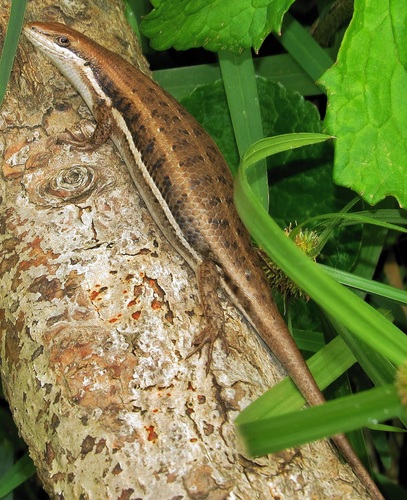
Variable Skink
Trachylepis varia
A shimmering, agile resident of African gardens, the Variable Skink is a master of the 'sun-and-scuttle' lifestyle. With its bronzy scales and lightning-fast reflexes, it is one of the most rewarding reptiles to observe on your backyard camera.
Quick Identification
Size
Total length of 15-20 cm (6-8 inches); weight typically between 10-20 grams.
Colors
Bronzy-brown to olive back with dark flecks; a prominent pale or white stripe runs from the eye to the base of the tail; flanks are often darker with distinct white spots.
Key Features
- Distinct white lateral stripe from eye to tail
- White-spotted dark flanks
- Bronzy-brown dorsal coloration with dark flecks
- Slender build with a long, tapering tail
When You’ll See Them
Geographic range
Where Does the Variable Skink Live?
The Variable Skink is native to the diverse landscapes of East and Southern Africa. Its core range spans from the southern tip of South Africa, through Zimbabwe and Mozambique, reaching northward into Tanzania, Kenya, and parts of Ethiopia. It is one of the most widely distributed lizard species in the region, thriving in both the wild African bush and developed urban environments.
Basemap © OpenStreetMap contributors
Behavior
Variable Skinks are highly active, diurnal reptiles known for their love of sunshine. They spend a significant portion of their day 'shuttling'—alternating between basking on hot surfaces to raise their body temperature and darting into the shade or under cover to hunt. They are agile and alert, frequently seen scurrying across garden walls, rocky outcrops, or tree trunks with impressive speed.
These skinks are remarkably adaptable to human presence and are a common sight in suburban gardens. While they are generally solitary and territorial regarding their favorite basking spots, they can live in high densities if there is enough food and shelter. When a predator or human approaches, they are quick to retreat into the nearest crevice or under a pile of leaves, and like many skinks, they can autotomize (drop) their tails as a survival tactic.
EverydayEarth exclusive
Camera Tips
Capturing high-quality footage of a Variable Skink requires a strategic approach to their cold-blooded biology. Because these skinks rely on external heat, your best bet is to find a 'basking station.' Look for flat, dark-colored rocks, old logs, or brick garden walls that catch the morning sun. Place your camera facing these warm spots, as the skinks will reliably return to them daily to regulate their temperature before hunting.
Since these lizards are small, camera height is critical. Mount your camera no more than 6 to 10 inches off the ground. If your device allows, use a macro lens or adjust the focus to a short range (about 2-3 feet). Skinks are fast movers; setting your camera to a 'Burst Mode' or high-frame-rate video will ensure you capture more than just a blurry tail as they zip past. Look for 'scat'—small, dark droppings with a white tip—on stones to identify their preferred hangouts.
To encourage a skink to stay in front of the lens longer, you can create an attractive habitat feature. A small, shallow dish of water or a pile of flat stones with narrow gaps between them (a 'skink hotel') will provide them with a reason to linger. While they don't respond to traditional mammalian lures, the presence of flowering plants nearby attracts the insects they eat, naturally bringing the skinks into your camera's field of view.
Similar Species
Species that look similar or are commonly confused with Variable Skink.
Frequently Asked Questions
Record Variable Skink at your habitat
Connect a camera to start building your own species record — AI identifies every visitor automatically.