Ratel
Mellivora capensis
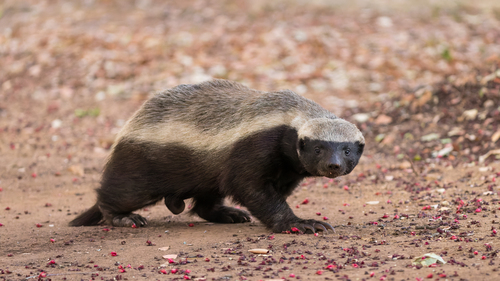
The Ratel is the ultimate survivor, a thick-skinned marvel of the animal kingdom that fears nothing and eats everything. With its iconic silver-and-black coat and relentless energy, it is one of the most rewarding species to capture on a trail camera.
Quick Identification
Size
Length: 55–77 cm (22–30 in); Weight: 6–16 kg (13–35 lbs)
Colors
A striking silver-grey or white 'mantle' covers the back from the crown to the tail base, contrasting sharply with jet-black underparts, face, and limbs.
Key Features
- Distinct white or grey mantle contrasting with a black underbelly
- Stocky, powerful build with thick, loose skin
- Long, heavy claws on the forefeet for digging
- Small, recessed ears and flat-topped head
When You’ll See Them
Sightings on EverydayEarth
Jun 26, 2026
Two honey badgers are resting together on the ground at night. The individual on the left, which has a prominent white mantle, briefly lifts its head and adjusts its front paws before settling back down. A very large, dark, stationary mass is visible in the far right of the frame, likely a rhinoceros sleeping just out of the main light.
Jun 24, 2026
A small group of White Rhinoceroses is gathered in a dry, sunlit clearing. A Ratel, or honey badger, trots across the center of the frame, passing between the rhinos with its characteristic white mantle clearly visible. Several Western Cattle-Egrets are also present, foraging on the ground in the vicinity of the rhinoceroses.
Jun 20, 2026
A group of White Rhinoceroses, including several calves, are busy feeding on hay scattered across the ground. A Honey Badger and several Common Warthogs are seen weaving between the rhinos, scavenging for food in the dusty enclosure under an overcast sky.
Jun 18, 2026
A quiet nighttime scene at the Hoedspruit Endangered Species Centre. Two animals are resting in a clearing under the cover of darkness. On the right, a honey badger is curled up, its distinctive white mantle clearly visible against its dark fur. To the left, a bush duiker lies peacefully on the ground, remaining still and alert.
Jun 18, 2026
A Honey Badger is seen active in the center of the frame, sniffing the ground and moving with its typical rolling gait. In the background, a Scrub Hare remains perfectly still while resting, with its large ears alert to the surroundings.
Jun 17, 2026
Under the cover of night, several White Rhinoceroses are resting or standing in a large clearing. In the center of the frame, a Honey Badger (Ratel) is actively foraging, moving purposefully across the ground. A small, unidentified bird is also seen hopping nearby, likely looking for insects disturbed by the larger animals.
Behavior
The Ratel, more famously known as the Honey Badger, is legendary for its fearlessness and resilience. While they are members of the weasel family, they possess an attitude that far exceeds their size, often standing their ground against much larger predators like lions or hyenas. They are largely solitary creatures, moving with a tireless, rolling gait as they forage across vast territories. Their intelligence is remarkable; they have been observed using tools and solving complex problems to reach food sources.
In terms of social patterns, Ratels are generally nomadic and non-territorial, though they use scent marking to communicate with other individuals in the area. While they have a reputation for being aggressive, they typically prefer to avoid human contact. However, they are notorious 'problem solvers' around farms and homesteads, where they can bypass intricate latches to reach poultry or beehives. Their loose, thick skin acts as a form of biological armor, allowing them to twist around and bite an attacker even when held by the scruff of the neck.
EverydayEarth exclusive
Camera Tips
Capturing a Ratel on camera requires strategy because they are constantly on the move and rarely follow the same path twice. For the best results, mount your camera low to the ground—about 12 to 18 inches high. This 'badger-eye view' captures their distinct mantle and powerful digging claws. Because they move with a steady, low-slung trot, a camera with a fast trigger speed (under 0.3 seconds) is essential to avoid getting a frame full of 'ghost' movement or just a disappearing tail.
We highly recommend using video mode rather than still photos. Ratels are incredibly active and seeing them dig, scent-mark, or interact with an object provides much more excitement than a static image. Set your video length to 15–20 seconds with a minimal 're-arm' time. If you are in a region where it is legal and appropriate, a scent lure can be a game-changer. Rather than using food which might be carried away, apply a fatty-acid oil or a commercial carnivore lure to a porous log or a rock. The Ratel’s powerful nose will lead it to the spot, and it will often spend several minutes investigating and scent-marking the area, giving you prime footage.
Look for 'natural hotspots' rather than random placement. Ratels are opportunistic diggers; look for fresh excavations or large holes under fences and fallen trees. They often return to check these spots for prey. If you have a beehive or a secure chicken coop, placing a camera nearby (facing outward) is a classic way to catch them as they investigate the perimeter. Finally, ensure your camera has a strong 'black flash' or invisible IR flash. While they are bold, sudden bright red glows from some trail cameras can occasionally spook them or lead the curious badger to bite and investigate your expensive equipment!
Similar Species
Species that look similar or are commonly confused with Ratel.
Frequently Asked Questions
Record Ratel at your habitat
Connect a camera to start building your own species record — AI identifies every visitor automatically.