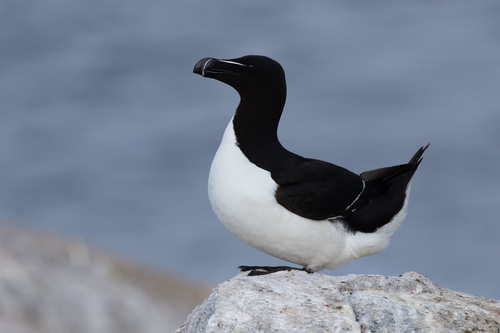
Razorbill
Alca torda
The Razorbill is the ocean's most dapper survivor, a master diver with a tuxedo-like appearance and a striking striped bill. As the closest living relative to the extinct Great Auk, this resilient seabird brings a sense of prehistoric wonder to the North Atlantic cliffs.
Quick Identification
Size
Length: 37–39 cm (14.5–15.5 in); Wingspan: 63–68 cm (25–27 in); Weight: 500–900 g (1.1–2.0 lbs)
Colors
Deep jet-black upperparts and head with a starkly contrasting snow-white belly. A thin white line extends from the eye to the beak, and the black bill features a prominent vertical white band.
Key Features
- Thick, blunt black bill with a distinctive vertical white stripe
- Pointed tail that often tilts upward when swimming
- Jet black back and head contrasting with a bright white chest
- Thin white line extending from the eye to the base of the beak
When You’ll See Them
Behavior
Unlike many other birds, Razorbills are exceptional underwater 'fliers.' They use their powerful wings to propel themselves deep into the water column—sometimes reaching depths of over 100 meters—to hunt for schooling fish. While they are wary of human presence, they are quite focused on their social duties at the colony, making them a fascinating subject for remote observation as they guard their single egg or ferry fish back to their chick.
EverydayEarth exclusive
Camera Tips
Capturing the Razorbill on a trail camera requires a specialized approach since they are strictly coastal birds. Because they nest in deep rocky crevices or under large boulders rather than on open ledges, you should position your camera low to the ground—about 12 to 18 inches high. Angle the lens slightly upward if the camera is tucked into a crevice, or downward if you are monitoring a 'club' rock where birds gather to socialize. Ensure the camera is securely mounted to resist the high winds common in coastal environments.
Our most successful captures come from placing cameras near 'loafing ledges' or 'socialization rocks.' These are flat areas near the nesting sites where non-breeding birds and off-duty parents congregate to preen and interact. You don't need bait for these birds; instead, look for areas with high concentrations of white guano (droppings), which indicates a high-traffic zone. Set your camera to take a 3-5 shot burst. Razorbills are incredibly fast when landing or taking off, and a single photo often misses the most dramatic action.
Coastal lighting can be harsh, often 'blowing out' the bright white chest of the bird. If your camera has adjustable settings, try reducing the exposure compensation to -0.5 or -1.0 to preserve the detail in their white feathers. Since salt spray is a major issue, we recommend using a protective housing and cleaning the lens with a microfiber cloth every few days. The best time for action shots is during the morning when birds are most active returning from sea with bills full of fish for their chicks.
Similar Species
Species that look similar or are commonly confused with Razorbill.
Common Murre
Features a much thinner, pointed black beak and lacks the white vertical stripe found on the Razorbill.
Atlantic Puffin
Easily distinguished by its smaller size, bright orange legs, and colorful triangular beak.
Black Guillemot
Has bright red feet and large white wing patches, whereas the Razorbill has black feet and solid black wings (except for a thin trailing edge).
Frequently Asked Questions
Record Razorbill at your habitat
Connect a camera to start building your own species record — AI identifies every visitor automatically.