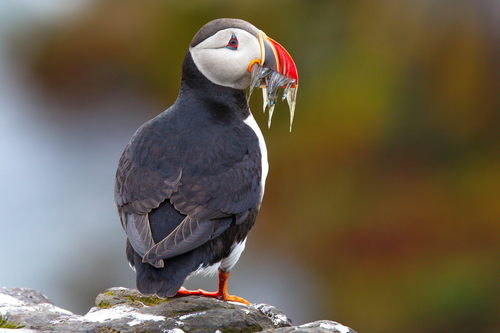
Atlantic Puffin
Fratercula arctica
The Atlantic Puffin is the 'clown of the sea,' a hardy maritime survivor that braves the North Atlantic's fiercest storms before returning to coastal cliffs with a beak full of silver fish.
Quick Identification
Size
26-29 cm (10-11 in) in length; wingspan of 47-63 cm (18-25 in); weight 310-480 g (11-17 oz)
Colors
Jet black back and wings with snowy white underparts; pale grey-to-white cheeks; seasonal beak is bright orange with yellow and blue-grey highlights; legs and feet are a vivid orange.
Key Features
- Massive, colorful triangular bill
- Striking white face with a dark eye-stripe
- Compact, upright penguin-like posture on land
- Bright orange webbed feet
When You’ll See Them
Geographic range
Where Does the Atlantic Puffin Live?
The Atlantic Puffin is the only puffin species native to the North Atlantic Ocean. Its primary range stretches from the coastal cliffs of the northeastern United States and Atlantic Canada over to Iceland, Norway, Greenland, and the British Isles. While they are most concentrated in Iceland and the Faroe Islands during the summer breeding months, they transition to a nomadic lifestyle across the open sea as far south as the Mediterranean and North Carolina during the winter.
Basemap © OpenStreetMap contributors
Behavior
Atlantic Puffins are highly social seabirds that spend the majority of their lives at sea, coming to land only for a few months each year to breed. They are exceptional divers, using their short wings like flippers to 'fly' through the water in pursuit of fish. On land, they display fascinating social rituals, such as 'billing,' where a pair rubs their beaks together to strengthen their bond. They are colonial nesters, often living in groups of thousands on grassy clifftops.
Despite their somewhat clumsy appearance on land, where they walk with a distinct waddle, they are incredibly efficient in the air, beating their wings up to 400 times per minute to reach speeds of 55 mph. They are generally wary of humans but can become accustomed to observers at popular nesting sites, though they should never be approached closely enough to disrupt their flight paths to their burrows.
EverydayEarth exclusive
Camera Tips
Capturing the Atlantic Puffin requires strategic placement near their nesting burrows. Because these birds return to the same holes in the ground year after year, look for areas with high burrow density on clifftops. Place your camera roughly 2-3 feet off the ground, ensuring it is securely weighted or staked down; coastal winds are notoriously strong and can cause motion-trigger errors or even blow your equipment away. Angle the camera toward a flat rock near a burrow entrance, as puffins often use these 'landing pads' to look around before entering their nests.
Lighting is your biggest challenge due to the puffin's high-contrast feathers. The bright white chest and dark black back can easily cause 'blown out' highlights in midday sun. Set your camera to target the golden hours—shortly after sunrise or before sunset—to capture the true saturation of their orange beaks. If your camera allows for shutter speed adjustments, keep it fast (above 1/1000s) to freeze the motion of their rapid wingbeats if they fly across the frame.
Avoid using any food lures or artificial baits, as these can disrupt the natural feeding cycles of the colony and attract predators like gulls. Instead, focus on 'loafing' areas where non-breeding birds or off-duty parents congregate. If you are using an AI-powered camera, ensure the detection zone is focused on the burrow entrance to capture the iconic 'fish-filled beak' shots as parents return from the sea. Always maintain a respectful distance to ensure the puffins don't feel blocked from their chicks.
Similar Species
Species that look similar or are commonly confused with Atlantic Puffin.
Razorbill
Has a heavy, blunt black beak with a thin white line and lacks the puffin's bright facial colors.
Black Guillemot
Smaller with a thin, pointed black beak and bright red feet; features large white wing patches.
Horned Puffin
Found in the Pacific Ocean; has a small 'horn' above the eye and a more yellow base to the beak.
Frequently Asked Questions
Record Atlantic Puffin at your habitat
Connect a camera to start building your own species record — AI identifies every visitor automatically.