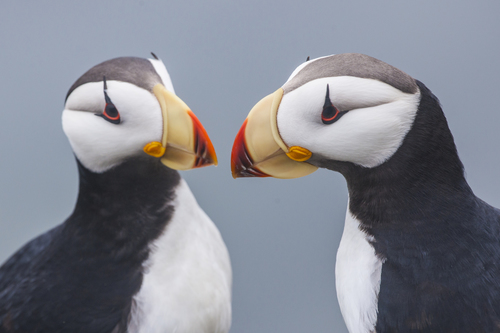
Horned Puffin
Fratercula corniculata
Meet the 'Sea Parrot' of the North Pacific, a dapper diving bird famous for its vibrant bill and unique fleshy horns. Whether soaring over the waves or nesting on vertical cliffs, the Horned Puffin is a master of the maritime wilderness.
Quick Identification
Size
Length: 36–41 cm (14–16 in); Wingspan: 56–58 cm (22–23 in); Weight: 450–700 g (1–1.5 lbs)
Colors
Striking white face and underparts with a black back, neck, and crown. The bill is bright yellow with a red tip during breeding season, and feet are a vibrant orange-red.
Key Features
- Thick, triangular yellow and red bill
- Fleshy black 'horn' extending upward from the eye
- White cheek patches during breeding season
- Upright, penguin-like stance on land
When You’ll See Them
Geographic range
Where Does the Horned Puffin Live?
The Horned Puffin is a true native of the North Pacific, spanning a vast arc from the icy shores of Siberia to the rugged coastlines of North America. Its core range is centered in the Aleutian Islands and coastal Alaska, though it regularly wanders south into British Columbia and occasionally as far as California during the winter months. Unlike some seabirds, these puffins stay primarily within the subarctic and temperate waters of the Pacific Rim, nesting on remote, rocky islands where predators are few.
Basemap © OpenStreetMap contributors
Behavior
Horned Puffins are remarkably resilient seabirds that spend the vast majority of their lives at sea. They are exceptional divers, using their wings to 'fly' through the water in pursuit of small schooling fish. Unlike their Atlantic cousins who often dig burrows in the soil, Horned Puffins typically nest in deep rock crevices or among shoreline boulders, providing them with natural protection from aerial predators like gulls and eagles.
In their social lives, these birds are colonial nesters, often gathering in groups of thousands during the summer months. While they are relatively silent at sea, they produce low, growling sounds within their nesting crevices. They exhibit high site fidelity, often returning to the exact same rocky crack year after year to reunite with their long-term mate. Their interactions with humans are limited due to their remote habitat, but they are known for their curious nature when approached cautiously by boat.
EverydayEarth exclusive
Camera Tips
Capturing a Horned Puffin on a trail camera requires targeting their specific 'landing pads'—the flat rocky outcroppings just outside their nesting crevices. Because these birds return to the same crevices repeatedly, you should position your camera at a low height (about 12-18 inches) facing a known entrance. Use a fast trigger speed, as puffins are notoriously quick when landing and can vanish into a crack in seconds.
Lighting is a major challenge in their foggy, maritime environments. Set your camera to a higher ISO or use a model with strong high-dynamic-range (HDR) capabilities to prevent the bright white feathers of the puffin's chest from 'blowing out' against the dark rocky background. Since salt spray and guano are common on puffin cliffs, housing your camera in a waterproof, easy-to-clean case is essential for long-term deployments.
While you cannot easily bait puffins with food, they are highly social and visually oriented. If you are monitoring a private coastal area, placing a realistic puffin decoy within the camera's field of view can encourage passing birds to land and investigate, leading to much better 'hero shots.' Focus your efforts during the chick-rearing months of July and August, when adults are constantly flying back and forth with mouths full of fish.
Similar Species
Species that look similar or are commonly confused with Horned Puffin.
Frequently Asked Questions
Record Horned Puffin at your habitat
Connect a camera to start building your own species record — AI identifies every visitor automatically.