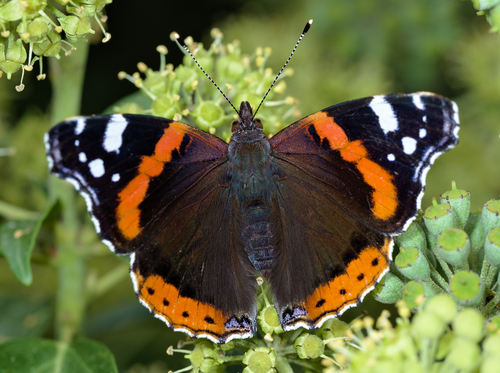
Red Admiral
Vanessa atalanta
With their striking red bands and fearless personality, Red Admirals are the charismatic generals of the backyard garden. These migratory wonders are as likely to land on your shoulder as they are on a flower.
Quick Identification
Size
Wingspan of 4.5–7.6 cm (1.75–3 inches)
Colors
Velvety black wings with vibrant orange-red diagonal bands and white spots at the forewing tips; underside is a camouflaged mosaic of brown, blue, and black.
Key Features
- Bold orange-red 'V' shaped bands across black wings
- Distinct white spots on the outer tips of the forewings
- Mottled brown underside that mimics a dead leaf when wings are closed
- Unusually bold behavior, often landing on people or bright objects
When You’ll See Them
Geographic range
Where Does the Red Admiral Live?
The Red Admiral is a truly global traveler, native across the temperate reaches of North America, Europe, and Asia. From the sunny coasts of North Africa to the lush gardens of the United Kingdom and the vast landscapes of the United States and Canada, this resilient butterfly is a familiar sight across the Northern Hemisphere. While they are year-round residents in warmer southern regions, they are famous for their northward migrations each spring, reaching as far as subarctic regions before retreating or seeking shelter for the winter.
Basemap © OpenStreetMap contributors
Behavior
Red Admirals are famous for their surprisingly bold and inquisitive nature. Unlike many butterflies that flutter away at the slightest movement, Red Admirals are known to land on humans, attracted by the salt on our skin or simply using us as convenient perching spots. They are highly territorial insects; males will select a sun-drenched spot—often a prominent leaf, fence post, or tree trunk—and patrol it vigorously, chasing away rival males and even large birds that venture too close.
These butterflies are sun-worshippers, spending much of their morning basking with their wings spread wide to absorb heat. Their flight is rapid and erratic, but when they find a food source, they become very focused. They are often seen 'pumping' their wings slowly while feeding on nectar or tree sap. Unlike many other species, they are also quite active in the late afternoon and early evening, sometimes remaining on the wing until dusk.
EverydayEarth exclusive
Camera Tips
To capture the best images of Red Admirals, focus your camera on 'fermentation stations.' While most butterflies are strictly nectar-feeders, Red Admirals are highly attracted to the sugars in rotting fruit. Set up a low platform or hang a mesh feeder containing sliced overripe bananas, peaches, or watermelon. Position your AI-powered camera 12–18 inches away from the bait, angled slightly downward to capture the vibrant dorsal (top-side) wing patterns when they land to feed.
Another excellent strategy is to locate their favorite perching spots. Look for sun-drenched wooden fence posts, dark tree trunks, or large flat stones that receive direct sunlight between 10 AM and 2 PM. These butterflies are creatures of habit and will return to the same sunny 'lookout' repeatedly to defend their territory. Mount your camera on a nearby branch or tripod to catch them in a resting position with their wings fully expanded.
If you want to document their entire life cycle, aim your camera at a patch of stinging nettles (Urtica dioica). This is their primary host plant. Look for 'leaf tents'—folded leaves stitched together with silk—where the caterpillars hide. Using a macro lens or a close-focus setting on your trail camera can help you capture the intricate details of the caterpillars or the female Red Admiral as she deposits her tiny, greenish eggs on the leaves.
Similar Species
Species that look similar or are commonly confused with Red Admiral.
Frequently Asked Questions
Record Red Admiral at your habitat
Connect a camera to start building your own species record — AI identifies every visitor automatically.