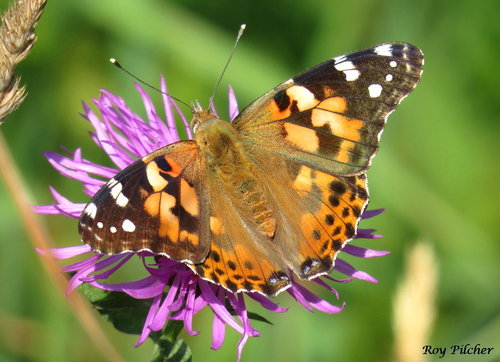
Painted Lady
Vanessa cardui
Known as the "Cosmopolitan" butterfly, the Painted Lady is the world's most frequent flyer. With its stunning orange-and-black mosaic wings, it is a hardy and beautiful visitor to gardens across nearly every continent.
Quick Identification
Size
Wingspan of 5–9 cm (2.0–3.5 inches)
Colors
Salmon-pink to orange base with black and white patterned wing tips; underside is mottled gray, brown, and white with small blue eyespots.
Key Features
- Large white spots on black-tipped forewings
- Orangish-pink base color with black mottling
- Four or five small, blue-centered eyespots on the underside of each hindwing
- Fast, erratic, skipping flight pattern
When You’ll See Them
Sightings on EverydayEarth
Jul 10, 2026
A small group of Dik-diks is resting and interacting under the shade of a dense, thorny thicket. On the left, one individual stands alert, occasionally turning its head to survey the area. To the right, two others are close together, with one appearing to gently groom the other's neck. Strong wind gusts are visibly swaying the leafless branches of the overhead cover.
Geographic range
Where Does the Painted Lady Live?
The Painted Lady is the most widely distributed butterfly on Earth, found on every continent except Antarctica and South America. In North America, they are common from the Arctic Circle down to Mexico, while in the Old World, they migrate between Africa and Europe, sometimes crossing the Sahara Desert in massive waves. Because they are highly nomadic, their local abundance varies significantly from year to year depending on environmental conditions in their primary breeding grounds.
Basemap © OpenStreetMap contributors
Behavior
The Painted Lady is the ultimate world traveler, known for spectacular, nomadic migrations that can span thousands of miles across continents. Unlike many butterflies that follow a rigid seasonal path, Painted Ladies move in response to environmental triggers like rainfall and food availability. They are sun-loving creatures, often seen basking on flat stones or bare ground to regulate their body temperature before taking flight.
In the garden, they are social but industrious, fluttering from flower to flower with a distinctive "skipping" flight. They are less aggressive than territorial species like the Red Admiral, making them a peaceful addition to any backyard ecosystem. While they are usually solitary during feeding, you may see dozens or even hundreds together during peak migration years, a phenomenon often driven by heavy rains in their desert breeding grounds.
EverydayEarth exclusive
Camera Tips
To capture the Painted Lady with an AI-powered camera, focus on "hot spots" like nectar-rich flower beds or basking stones. Place your camera at a low height—roughly 12 to 24 inches off the ground—angled slightly upward to catch the vibrant colors of the upper wings and the intricate patterns of the underwings when they land. Since these butterflies are cold-blooded, they are most active when the sun hits your garden directly; position your camera to face north or south to avoid direct lens flare while ensuring the subject is well-lit.
While most backyard cameras are triggered by motion, the small size of a butterfly can sometimes fail to trip a standard PIR sensor. If your camera allows, use a "Time Lapse" mode with a short interval (e.g., every 30 seconds) during peak sun hours. To lure them into the frame, plant high-nectar "landing pads" like Zinnias or Purple Coneflowers. Unlike some butterflies, Painted Ladies are less attracted to rotting fruit and more attracted to fresh, vibrant blossoms and even damp, mineral-rich mud patches—a behavior called puddling.
For the best results, use a camera with a fast shutter speed to freeze their rapid wing beats. If you are using a trail camera, look for a model with a close-focus or macro lens capability, as standard trail cams often have a minimum focus distance of 3-5 feet, which might leave a small butterfly looking blurry. Placing a decorative flat rock in a sunny spot right in front of the lens can provide a predictable "stage" for the butterfly to bask, giving you the perfect high-resolution still.
Similar Species
Species that look similar or are commonly confused with Painted Lady.
Monarch
Much larger than the Painted Lady, the Monarch has thick black wing veins and lacks the white-spotted black forewing tips.
American Lady
Very similar in color, but the American Lady has two large eyespots on the underside of the hindwing, whereas the Painted Lady has four or five small ones.
Red Admiral
Identifiable by its darker black base color and a bold, bright orange-red band forming a distinctive 'S' shape across the wings.
Frequently Asked Questions
Record Painted Lady at your habitat
Connect a camera to start building your own species record — AI identifies every visitor automatically.