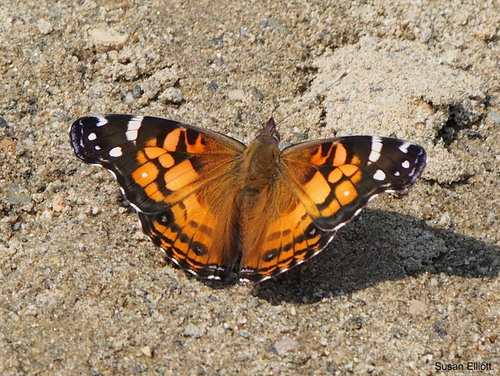
American Lady
Vanessa virginiensis
A master of disguise with hidden 'eyes' on its wings, the American Lady is a vibrant visitor to sunny backyards across North America.
Quick Identification
Size
Wingspan of 1.75 to 2.6 inches (4.4 to 6.7 cm)
Colors
Upper wings are orange and black with white spots near the tips; the underside of the hindwing features a distinctive cobweb pattern with two large blue-centered eyespots.
Key Features
- Two large, prominent eyespots on the underside of each hindwing
- Small white spot located within an orange patch on the forewing tip
- Intricate white 'cobweb' pattern on the brown underside of the hindwings
- Orange upper wings with heavy black margins and white spots
When You’ll See Them
Geographic range
Where Does the American Lady Live?
Native to the North American continent, the American Lady is widely distributed from southern Canada across the entire United States and south into Mexico and Central America. While they are most abundant in the eastern half of the U.S., they are also frequent visitors to mountainous regions in the West. Some populations are even found in the Greater Antilles and occasionally as far south as Colombia, making them one of the most widespread brush-footed butterflies in the New World.
Basemap © OpenStreetMap contributors
Behavior
The American Lady is a fast, powerful flier known for its erratic but purposeful flight patterns. Unlike some more skittish species, these butterflies are often quite approachable when they are focused on nectaring at flowers. Males are highly territorial and can often be seen perching on bare ground or low vegetation in sunny spots, darting out to investigate any passing insect that might be a potential mate or a rival.
These butterflies are also famous for their unique larval behavior. The caterpillars are 'architects' of sorts, constructing individual silk nests among the leaves and flowers of their host plants, typically everlastings or pussytoes. This behavior provides them with protection from predators and the elements while they feed. In the adult stage, they are frequently seen basking with their wings spread wide to soak up the morning sun before beginning their daily search for nectar and mates.
EverydayEarth exclusive
Camera Tips
To capture high-quality images of the American Lady with an AI-powered camera, placement is everything. Focus your camera on a 'pollinator hotspot'—a cluster of sun-drenched nectar plants like Purple Coneflower or Zinnias. Because these butterflies are cold-blooded, they are most active when the sun is hitting the flowers directly, so ensure your camera isn't shaded during the peak hours of 11 AM to 3 PM.
Since butterflies are small and move quickly, set your camera's shutter speed to a high setting to freeze the motion of their wings. If your camera allows for macro or close-focus settings, use them! Positioning the lens within 2 to 3 feet of a favorite nectar source will yield the best results for AI identification, as the fine details of the wing spots are crucial for distinguishing them from the closely related Painted Lady.
Don't just look for them on flowers; American Ladies love to bask on flat, dark surfaces to raise their body temperature. Placing a few flat stones in a sunny spot near your flower bed can provide a perfect stage for a resting butterfly. This 'perching' behavior is ideal for trail cameras because the insect remains still for several minutes, allowing the AI to lock on and capture a series of clear, high-resolution frames.
Similar Species
Species that look similar or are commonly confused with American Lady.
Frequently Asked Questions
Record American Lady at your habitat
Connect a camera to start building your own species record — AI identifies every visitor automatically.