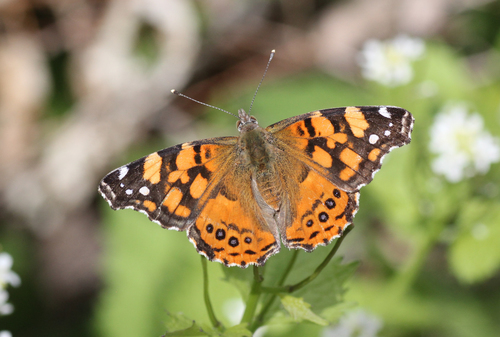
West Coast Lady
Vanessa annabella
A vibrant orange jewel of the American West, the West Coast Lady is a territorial sun-lover that brings life to backyard gardens from British Columbia to Mexico.
Quick Identification
Size
Wingspan ranges from 41 to 57 mm (1.6 to 2.2 inches)
Colors
Bright orange-to-tawny upper wings with black markings and white spots; characterized by a distinct orange bar on the leading edge of the forewing
Key Features
- Orange subapical bar on the forewing (distinct from the white bar in other ladies)
- Square-tipped or 'clipped' forewing shape
- Four small blue-centered eyespots on the upper hindwing
- Marbled gray, brown, and white underside for camouflage
When You’ll See Them
Geographic range
Where Does the West Coast Lady Live?
Native to the western half of North America, the West Coast Lady is a staple of the Pacific landscape. Its core range extends from southwestern Canada through the western United States—particularly California and the Great Basin—and down into the highlands of northern Mexico. While it is most concentrated near the coast and in the southwestern deserts, it is a frequent sight in mountain meadows and urban parks throughout the Western interior.
Basemap © OpenStreetMap contributors
Behavior
The West Coast Lady is a highly active and energetic butterfly often seen darting through gardens and open meadows. Unlike many other butterflies that flutter aimlessly, males of this species exhibit strong territorial behavior. They are known for 'hilltopping,' where they seek out high ground or prominent perches in the afternoon to wait for passing females, aggressively chasing away rivals that enter their space.
These butterflies are sun-lovers and spend a significant portion of their morning basking with wings wide open to regulate their body temperature. In gardens, they are quite bold and can often be approached closely if they are preoccupied with nectaring. While they are not as famous for migration as the Monarch, they do undergo seasonal movements, shifting north in the spring and returning south in the autumn to avoid freezing temperatures.
EverydayEarth exclusive
Camera Tips
To capture high-quality images of the West Coast Lady, position your camera near their favorite nectar sources. Plants like Butterfly Bush (Buddleia), Zinnias, and native Thistles are magnets for these insects. Since they are ground-oriented baskers, setting your camera at a low angle (about 2 to 3 feet off the ground) pointed toward a sunny patch of dirt or a flat rock will often yield excellent results as they land to warm themselves.
Lighting is critical for insect photography; ensure your camera is positioned so the sun is behind the lens or hitting the subject from the side to highlight the iridescent blue centers of their eyespots. High shutter speeds are necessary because even when landed, their wings may quiver. If using a motion-activated camera, ensure it has a 'macro' or 'close-focus' setting, as these butterflies are small enough that they won't trigger standard long-range sensors effectively.
Seasonal timing is key. In the spring, focus your efforts near larval host plants like Mallow (Malva) or Hollyhocks. You might catch the females laying eggs or the newly emerged adults resting. During the peak heat of summer, cameras near water sources or damp soil (mud-puddling sites) can capture them as they drink to mineralize.
Similar Species
Species that look similar or are commonly confused with West Coast Lady.
Frequently Asked Questions
Record West Coast Lady at your habitat
Connect a camera to start building your own species record — AI identifies every visitor automatically.