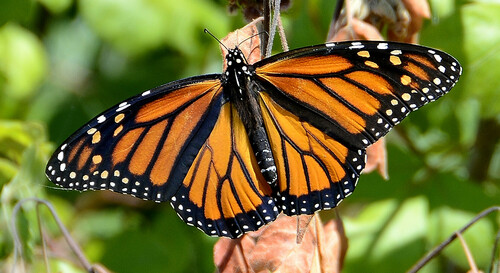
Monarch
Danaus plexippus
The Monarch is the crown jewel of the backyard garden, famous for its vibrant orange wings and its legendary multi-generational migration across the continent.
Quick Identification
Size
8.9–10.2 cm (3.5–4.0 in) wingspan; weight ranges from 0.25 to 0.75 grams
Colors
Brilliant orange wings with black veins and a black border containing white spots; males have thin veins and two black scent spots on hindwings, while females have thicker veins and no spots.
Key Features
- Bright orange wings with heavy black veining
- Black border with white spots along wing edges
- Slow, flapping-and-gliding 'V' flight pattern
- Males feature a distinct black spot on each hindwing
When You’ll See Them
Geographic range
Where Does the Monarch Live?
Native to North America, the Monarch is most famous for its incredible migratory path spanning from southern Canada through the United States to central Mexico. Beyond the Americas, these butterflies have successfully colonized Hawaii, Australia, and New Zealand, where they are often called Wanderers. They are also occasionally spotted in Western Europe and North Africa, though their heartland remains the temperate regions of the Western Hemisphere.
Basemap © OpenStreetMap contributors
Behavior
Monarchs are world-renowned for their spectacular multi-generational migration. Unlike most butterflies, they cannot survive the freezing winters of the north, so they travel thousands of miles to overwintering sites in central Mexico or coastal California. The most fascinating aspect of their behavior is that the butterflies returning north in the spring are the great-grandchildren of those that flew south the previous fall.
During the day, Monarchs are active foragers, flitting from flower to flower to fuel up on nectar. They are relatively bold and slow fliers because they are chemically protected; the milkweed they eat as caterpillars makes them toxic to most predators. When not feeding, they can be seen 'basking' with wings wide open to soak up the sun's warmth, which is necessary for their flight muscles to function.
EverydayEarth exclusive
Camera Tips
Capturing a Monarch on a backyard camera requires a 'station-based' approach rather than a trail-based one. Because insects are too small and move too quickly to reliably trigger standard PIR (Passive Infrared) motion sensors on many trail cameras, you should set your camera to 'Time Lapse' mode or use a specialized AI-powered bird or insect camera. Position the camera about 12 to 24 inches away from a high-nectar 'landing pad' plant like Zinnias, Butterfly Bush, or Milkweed blooms.
Lighting is critical for butterfly photography. Monarchs are most active when the sun is high and the temperature is above 60°F (15°C). Aim your camera so the sun is behind you or to the side to illuminate the vibrant orange wings; backlighting can also be beautiful as it makes the wings look like stained glass, but it may cause the camera to underexpose the subject. A clean, green background will help the orange and black patterns pop in your footage.
If your camera has a 'High Sensitivity' setting for motion, enable it, but be prepared for many 'false' triggers from moving leaves. The best strategy is to focus on a specific cluster of flowers. During the peak of summer, Monarchs will visit the same patches of flowers repeatedly. If you are using a DSLR-based trail cam or a high-end AI camera, use a fast shutter speed (at least 1/1000s) to freeze the motion of their wings during takeoff and landing.
Similar Species
Species that look similar or are commonly confused with Monarch.
Frequently Asked Questions
Record Monarch at your habitat
Connect a camera to start building your own species record — AI identifies every visitor automatically.