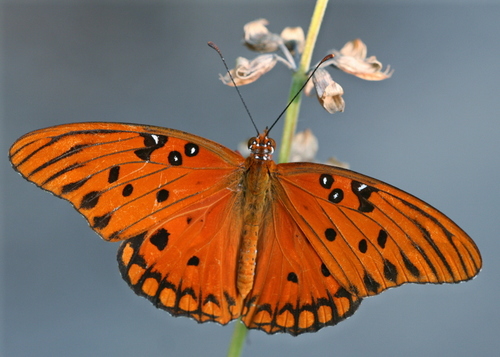
Gulf Fritillary
Dione vanillae
A sun-chasing longwing butterfly known for its brilliant orange wings and shimmering metallic silver spots. A staple of the American backyard, this vibrant flyer is a favorite for garden enthusiasts and nature photographers alike.
Quick Identification
Size
Wingspan of 6.5–9.5 cm (2.5–3.75 inches)
Colors
Bright orange upper wings with black markings and three white spots on the forewing edge; undersides are brownish-orange with elongated, brilliant metallic silver spots.
Key Features
- Elongated, narrow forewings typical of longwing butterflies
- Bright metallic silver spots on the wing undersides
- Three black-rimmed white spots on the upper forewing edge
- Fast, erratic flight pattern
When You’ll See Them
Geographic range
Where Does the Gulf Fritillary Live?
Native to the Americas, the Gulf Fritillary occupies a vast range extending from the southern United States through Central America and across much of South America. In North America, they are most abundant in the Sun Belt, particularly in Florida, Texas, and California, though they frequently migrate northward during the summer as far as the central plains and the mid-Atlantic. They are also common residents throughout the West Indies and as far south as Argentina, making them one of the most widely distributed butterflies in the Western Hemisphere.
Basemap © OpenStreetMap contributors
Behavior
The Gulf Fritillary is a sun-loving powerhouse of the garden, known for its rapid and nervous flight. Unlike some butterflies that glide gracefully, these insects are high-energy flyers that spend much of their day darting between nectar sources. They are highly active during the hottest parts of the day, often seen basking with their wings wide open to soak up solar energy.
Interestingly, these butterflies have a complex relationship with their host plants. While they are beautiful to look at, they possess a chemical defense mechanism; as caterpillars, they ingest toxins from passionvines that make both the larvae and the adult butterflies unpalatable to birds and other predators. In the garden, they are relatively bold and will often continue feeding while humans are nearby, provided there are no sudden movements.
EverydayEarth exclusive
Camera Tips
To capture high-quality footage of the Gulf Fritillary, position your AI-powered camera near their primary host plant: the Passionflower (Passiflora). Since females spend significant time hovering and landing on these vines to lay eggs, a camera focused on the tender new growth or the underside of leaves will provide excellent views of their intricate markings and egg-laying behavior.
For nectar-feeding shots, aim your camera at clusters of purple or orange flowers like Lantana or Zinnias. Set your camera at a height of 2 to 4 feet, roughly level with the blossoms. Because Gulf Fritillaries are fast flyers, use a camera with a high frame rate or a fast trigger speed to avoid motion blur. If your camera allows for macro settings, this is the perfect species to showcase the stunning, reflective silver spots on the underside of their wings.
Pay attention to the light; these butterflies are most active in full sun. Ensure your camera isn't pointing directly into the sun to avoid lens flare, but choose a well-lit spot where the butterfly’s orange wings will appear vibrant. Mid-morning to early afternoon is the golden window for activity, especially on warm, windless days when butterflies are less likely to be tossed about by the breeze.
Similar Species
Species that look similar or are commonly confused with Gulf Fritillary.
Monarch
Monarchs have broader wings with heavy black veins and white-spotted black borders; they lack the metallic silver spots found on the Gulf Fritillary.
Mexican Silverspot
Similar silver spots underneath, but the Mexican Silverspot has more rounded wings and a darker, more brownish-orange base color.
Variegated Fritillary
Has shorter, more rounded wings and lacks the brilliant metallic silver spots on the underside, featuring a more checkered pattern instead.
Frequently Asked Questions
Record Gulf Fritillary at your habitat
Connect a camera to start building your own species record — AI identifies every visitor automatically.