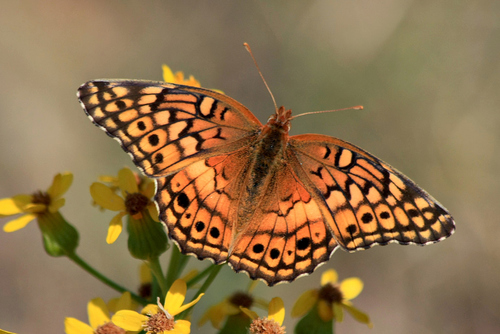
Variegated Fritillary
Euptoieta claudia
A restless nomad of the Americas, the Variegated Fritillary dazzles with its checkered orange wings and incredible speed. Unlike other fritillaries, this wanderer is a frequent guest in backyard gardens, constantly searching for sun-drenched flowers and host plants.
Quick Identification
Size
Wingspan of 4.5–8 cm (1.75–3.125 inches)
Colors
Bright orange upper wings with black checkered patterns and a dark border; underside is a variegated 'dead leaf' pattern of tan, cream, brown, and burnt orange.
Key Features
- Checkered orange and black upper wings
- Lack of silver spots on the wing underside
- Submarginal row of black spots on hindwing
- Low, swift, and erratic flight pattern
When You’ll See Them
Geographic range
Where Does the Variegated Fritillary Live?
Native to the Americas, the Variegated Fritillary is a true wanderer of the Western Hemisphere. Its core range stretches from the southern United States through Mexico and Central America, reaching as far south as Argentina and Chile. While they cannot survive harsh winters in the north, these nomadic butterflies frequently migrate into the northern United States and southern Canada during the summer months to breed and forage.
Basemap © OpenStreetMap contributors
Behavior
The Variegated Fritillary is a restless and highly active butterfly known for its nomadic lifestyle. Unlike many of its cousins that stay close to specific woodland edges, this species is a wanderer, often found patrolling open fields, meadows, and suburban lawns. Its genus name, Euptoieta, translates to 'easily scared,' which perfectly describes its skittish nature. Even when nectaring on a flower, it remains alert and will take flight at the slightest vibration or shadow.
Because they produce two to three broods per year, you may see them in various stages of their life cycle throughout the warmer months. They are sun-lovers and spend the majority of their time basking or feeding in wide-open, unshaded areas. Unlike the more sedentary Speyeria fritillaries, these butterflies do not mind traveling long distances to find fresh host plants, making them frequent visitors to backyard gardens that offer a variety of nectar sources.
EverydayEarth exclusive
Camera Tips
Capturing the Variegated Fritillary on camera requires patience due to its 'easily scared' nature. To get the best results, place your AI-powered camera near high-traffic nectar sources like butterfly weed or thistles. Because these butterflies fly low to the ground—usually within three feet of the grass—position your camera on a short tripod or mount it to a garden stake at knee height. Angle the lens slightly upward to catch the vibrant orange of the upper wings against the sky or downward to capture the intricate camouflaged underside while they are perched.
Since this species is nomadic and fast-moving, use a high shutter speed or a 'sports' mode if your camera settings allow. This will prevent motion blur during their swift, erratic flights. If you are using a triggered camera, set the sensitivity to high, as butterflies have a small profile and may not always trip PIR sensors unless they pass very close to the lens. Bright, midday sun is your friend here, as it brings out the saturation of their orange pigments and ensures they are active.
To encourage them to linger in front of the lens, consider creating a 'puddling' station. This is a small patch of damp sand or mud mixed with a tiny bit of sea salt. Variegated Fritillaries, especially males, will often land to sip minerals from the moisture, providing a rare opportunity for a still shot. If you have passionflower (Passiflora) or violets in your yard, focus your camera on these host plants during mid-summer to capture egg-laying behavior or the striking, spiked caterpillars.
Similar Species
Species that look similar or are commonly confused with Variegated Fritillary.
Frequently Asked Questions
Record Variegated Fritillary at your habitat
Connect a camera to start building your own species record — AI identifies every visitor automatically.