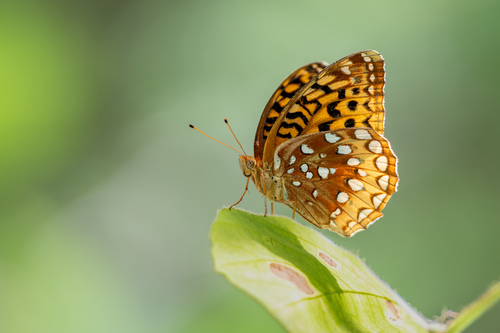
Great Spangled Fritillary
Argynnis cybele
With its shimmering silver-spangled wings and vibrant orange hue, the Great Spangled Fritillary is the crown jewel of the summer meadow. This powerful flyer is a favorite for backyard observers, bringing a touch of metallic elegance to any pollinator garden.
Quick Identification
Size
Wingspan of 3 to 4 inches (7.5 to 10 cm); body length approximately 1.5 inches (3.8 cm)
Colors
Bright orange upperside with black spots, dashes, and chevrons; underside of hindwing is reddish-brown with large, shimmering silver spots and a distinctive wide, pale yellow band
Key Features
- Large, metallic silver spots on the underside of the hindwing
- Broad pale yellow band between the two outer rows of silver spots
- Bright orange upperside with intricate black patterns
- One of the largest fritillary species in North America
When You’ll See Them
Geographic range
Where Does the Great Spangled Fritillary Live?
The Great Spangled Fritillary is a widespread native of North America, flourishing across a broad latitudinal range. Its territory extends from the southern reaches of Canada—stretching from British Columbia all the way to Nova Scotia—and covers much of the United States except for the arid Southwest and the Gulf Coast. It is particularly common in the Northeast, the Great Lakes region, and along the Appalachian Mountains, where the temperate climate and abundant rainfall support its preferred host plants.
Basemap © OpenStreetMap contributors
Behavior
The Great Spangled Fritillary is an energetic and powerful flier, often seen soaring through sun-drenched meadows and along the edges of deciduous forests. Unlike many butterfly species that produce multiple generations in a single season, this species has only one brood per year. Adults emerge in early summer, with males typically appearing a week or two before females to establish territories and patrol for mates. In the heat of late summer, females often enter a state of dormancy called diapause, hiding in cool, shaded areas before emerging in late August to lay their eggs.
These butterflies are highly active nectar-seekers and are frequently observed congregating on tall, colorful wildflowers. They are relatively approachable while feeding, especially when preoccupied with high-value nectar sources like thistles or milkweed. Interestingly, the females do not lay their eggs directly on their host plants; instead, they deposit them on leaf litter near violets, relying on the newly hatched caterpillars to find their way to the food source after overwintering.
EverydayEarth exclusive
Camera Tips
To successfully capture the Great Spangled Fritillary on an AI-powered backyard camera, you must focus on 'ambush' points rather than flight paths. Position your camera 12 to 18 inches away from cluster-style nectar plants like purple coneflower (Echinacea), Joe-Pye weed, or zinnias. These butterflies prefer 'landing pads' where they can perch for several minutes at a time. Use a 45-degree downward angle to ensure the camera captures both the orange upperside and the diagnostic silver spots on the wing undersides when they close their wings to feed.
Male fritillaries are frequently attracted to 'puddling' spots to intake minerals. You can create a specialized camera trap by placing a shallow tray of damp sand mixed with a very small amount of sea salt or compost in a sunny spot. Aim your camera at this tray; the butterflies will often remain stationary for long periods, allowing for high-quality, crisp images. Ensure the camera's shutter speed is set as high as possible, as even when perched, their wings may quiver rapidly.
Since these butterflies are most active in the peak heat of the day, choose a location with consistent lighting to avoid harsh shadows that might confuse AI identification. Mid-summer, particularly July, is the 'golden month' for this species. Avoid placing cameras near tall, wispy grasses that might cause false triggers on windy days. If you are specifically looking for caterpillars, you will need to use a camera with night-vision capabilities near violet patches, as the larvae are nocturnal and hide in the soil during the day.
Similar Species
Species that look similar or are commonly confused with Great Spangled Fritillary.
Aphrodite Fritillary
Slightly smaller with a much narrower pale yellow band on the hindwing underside and a small black spot near the wing base.
Atlantis Fritillary
Features noticeably darker wing margins and a more chocolate-brown background color on the underside of the hindwings.
Monarch
Similar orange and black coloring, but lacks the metallic silver spots on the underside and has distinct black veins throughout the wing.
Frequently Asked Questions
Record Great Spangled Fritillary at your habitat
Connect a camera to start building your own species record — AI identifies every visitor automatically.