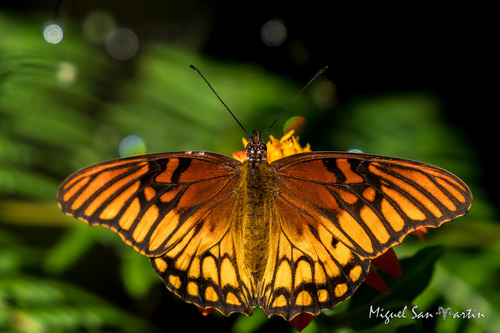
Mexican Silverspot
Dione moneta
A shimmering jewel of the tropics, the Mexican Silverspot dazzles with its bright orange wings and brilliant metallic underside. Common from Texas to the Andes, it is a high-energy visitor to sunny backyards and flower gardens.
Quick Identification
Size
Wingspan of 7.5 to 8.5 cm (3 to 3.4 inches)
Colors
Bright orange to tawny upperside with black veins; underside features large, elongated metallic silver spots on a brownish background.
Key Features
- Large reflective metallic silver spots on wing undersides
- Tawny-orange upperside with black-rimmed wing margins
- Elongated forewing shape typical of longwing butterflies
- Larvae are dark with branched spines and yellow markings
When You’ll See Them
Geographic range
Where Does the Mexican Silverspot Live?
The Mexican Silverspot is native to the Americas, with a range that spans from the southern United States through Mexico and Central America into the northern regions of South America. It is a permanent resident in tropical and subtropical zones, particularly in Mexico and Guatemala, while appearing as a frequent visitor or seasonal resident in South Texas and occasionally straying into New Mexico and Arizona. This species is well-adapted to varied elevations, found from coastal sea-level plains up to the high-altitude mountain slopes of the Andes.
Basemap © OpenStreetMap contributors
Behavior
The Mexican Silverspot is a powerful and energetic flyer, often seen darting through sun-drenched clearings and gardens with a purposeful, direct flight pattern. Unlike some more timid species, this butterfly is known for its territorial nature, with males frequently patrolling specific patches of flowers or host plants to ward off rivals and wait for potential mates. They are most active during the warmest parts of the day when they can be seen basking with their wings spread wide to soak up the sun's energy.
These butterflies are highly dependent on passionflower vines for their life cycle, and their behavior often centers around these plants. Females spend a significant amount of time hovering over foliage, using their chemical sensors to identify the perfect leaf for egg-laying. While they are solitary for the most part, you may find several individuals congregating around a particularly nectar-rich flowering bush, like Lantana, where they feed alongside other brush-footed butterflies.
EverydayEarth exclusive
Camera Tips
To successfully capture the Mexican Silverspot on a backyard camera, focus your efforts on 'landing zones.' These butterflies are fast and erratic in flight, so trying to catch them mid-air is difficult. Instead, position your camera 2 to 3 feet away from nectar-rich flowers like Lantana, Pentas, or Zinnias. Set your camera height to match the level of the blooms and use a tripod or stable mount to prevent motion blur. If your AI camera has a 'high sensitivity' or 'burst mode' setting, enable it; this species often flutters its wings even when perched, and a burst of photos increases your chances of getting a clear shot of the reflective silver spots.
Lighting is the most critical factor for this species because their namesake silver spots are highly iridescent. Place your camera so the sun is behind you or to the side of the field of view. When the sunlight hits the underside of the wings at the right angle, the silver spots will 'flash' on camera, creating a spectacular metallic effect. Mid-morning to early afternoon is the best time for this, as the butterflies are most active and the light is bright enough to fast-track your shutter speed, reducing motion blur.
For the best results, create a dedicated 'butterfly station' by planting Passionflower vines (Passiflora). These serve as host plants for their larvae and act as a magnetic attractant for breeding females. If you add a shallow 'puddling' dish filled with damp sand and a pinch of sea salt nearby, you may capture unique footage of the butterflies landing to sip minerals. Ensure your camera is protected from the direct heat of the sun, as these sunny spots can cause some devices to overheat during peak activity hours.
Similar Species
Species that look similar or are commonly confused with Mexican Silverspot.
Frequently Asked Questions
Record Mexican Silverspot at your habitat
Connect a camera to start building your own species record — AI identifies every visitor automatically.