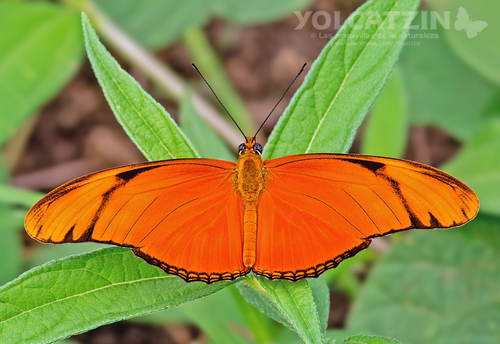
Julia Heliconian
Dryas iulia
A flash of brilliant orange in the tropical sun, the Julia Heliconian is one of the fastest and most vibrant butterflies in the Americas. Known for its 'flame-like' appearance, this long-winged beauty is a favorite of backyard gardeners and wildlife photographers alike.
Quick Identification
Size
Wingspan of 82 to 92 mm (3.2 to 3.6 inches)
Colors
Brilliant fluorescent orange with thin black borders. Males are bright orange; females are duller with more prominent black markings on the forewing.
Key Features
- Elongated and narrow forewings
- Vibrant, solid 'flame' orange color
- Fine black margins on wing edges
- Rapid, darting flight pattern
When You’ll See Them
Geographic range
Where Does the Julia Heliconian Live?
The Julia Heliconian is a quintessential butterfly of the American tropics, with a native range that begins in Brazil and stretches north through Central America and the Caribbean. In the United States, it is a permanent resident in the subtropical regions of southern Florida and southern Texas. During particularly warm summers, adventurous individuals are known to wander northward, with sightings recorded as far as eastern Nebraska and the Ohio Valley.
Basemap © OpenStreetMap contributors
Behavior
The Julia Heliconian is a fast-moving, energetic butterfly known for its rapid, erratic flight. Unlike many of its slower-moving relatives in the brush-footed family, the Julia is a 'sprinter,' often seen darting across open sunlit clearings or forest edges. They are highly sun-dependent and are most active during the brightest parts of the day, using their long wings to navigate through dense vegetation and gardens with surprising agility.
One of their most fascinating behaviors involves 'puddling'—gathering at damp soil or mud to intake essential minerals and salts. In the tropical parts of their range, they have even been observed drinking the tears of caimans and turtles to obtain sodium. They are relatively social at nectar sources but can be territorial, frequently chasing away other butterflies from a preferred flower patch. At night, they seek communal roosts in the safety of deep foliage.
EverydayEarth exclusive
Camera Tips
Capturing the Julia Heliconian on an AI-powered camera requires focusing on their high-energy foraging habits. Because they are rapid flyers, setting your camera near 'landing pads' rather than open flight paths is essential. Position your camera 2 to 4 feet off the ground, angled toward high-nectar flowers like Lantana, Firebush, or Shepherd's Needle. Since these butterflies are highly attracted to bright orange and red blooms, placing your camera near these colors will maximize your chances of a close-up.
To ensure a crisp image of such a fast mover, use a camera with a fast trigger speed or set it to a multi-shot burst mode. Lighting is the most critical factor for this species; they are sun-worshippers that rarely fly on cloudy days. Ensure your camera is placed in a spot that receives full morning and midday sun. Avoid deep shade, as the Julia will likely bypass these areas for brighter patches of the garden.
You can effectively lure Julia Heliconians into your camera's field of view by creating a mineral 'puddling station.' A shallow tray filled with moist sand and a small amount of sea salt or a few drops of fermented fruit juice will often ground them for several minutes, allowing for high-detail captures that are difficult to get while they are nectaring. If you have passionflower vines (Passiflora) in your yard, placing a camera near the tender new growth may also capture egg-laying behavior from the females.
Similar Species
Species that look similar or are commonly confused with Julia Heliconian.
Frequently Asked Questions
Record Julia Heliconian at your habitat
Connect a camera to start building your own species record — AI identifies every visitor automatically.