Viceroy
Limenitis archippus
Often mistaken for the Monarch, the Viceroy is a master of mimicry and a stunning addition to any wetland garden. With its bold orange wings and distinctive black 'line of beauty,' this resilient butterfly is a backyard favorite across North America.
Quick Identification
Size
Wingspan of 2.6 to 3.2 inches (6.6 to 8.1 cm)
Colors
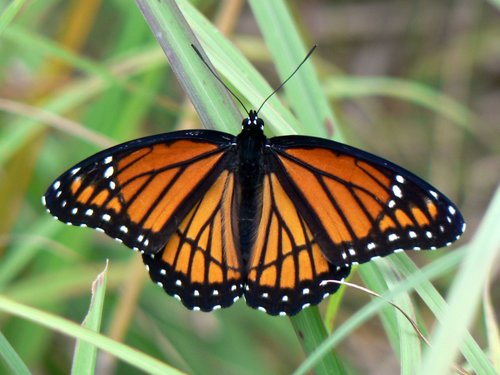
Deep orange-red with black veins and margins; white spots dot the outer black edges. Males and females are nearly identical in appearance.
Key Features
- Distinctive horizontal black line crossing the veins of the hindwing
- Bold black wing margins with white spots
- Rapid wing beats followed by short glides
- Similar to Monarch but generally smaller in size
When You’ll See Them
Geographic range
Where Does the Viceroy Live?
Native to the North American continent, the Viceroy claims a vast territory stretching from southern Canada through the majority of the United States and reaching into the northern reaches of Mexico. While they are absent from the Pacific Northwest and much of the Great Basin, they are a staple sight across the eastern and central regions of the continent wherever their preferred host trees grow. This expansive range makes them one of the most widely distributed brush-footed butterflies in the Nearctic region.
Basemap © OpenStreetMap contributors
Behavior
The Viceroy is a master of defensive evolution. For many years, scientists believed it was a Batesian mimic—a harmless species copying the appearance of a toxic one (the Monarch). However, modern research has revealed it is actually a Müllerian mimic. Because Viceroy caterpillars feed on willow leaves containing salicylic acid, the butterflies are bitter and unpalatable to birds, meaning both the Viceroy and the Monarch benefit from their shared warning colors.
Unlike many butterflies that float lazily from flower to flower, the Viceroy is quite energetic and can be surprisingly territorial. Males are known to perch on tall vegetation or tree branches, patrolling a specific area and aggressively chasing away other butterflies or even small birds that fly too close. Their flight style is a distinctive 'flap-flap-glide' pattern that differs from the slower, more rhythmic flapping of their Monarch cousins.
EverydayEarth exclusive
Camera Tips
Capturing the Viceroy on a backyard camera requires a focus on their specific lifecycle needs rather than traditional bird seed or suet. Because these butterflies are highly attracted to moisture and salt, placing a camera near a 'puddling' station—a shallow tray of damp sand or mud mixed with a tiny amount of sea salt—can yield incredible close-up footage. Position your camera on a tripod at a low angle, roughly 12 to 18 inches from the ground, to capture them as they land to drink and extract minerals.
Since Viceroys are most active during the warmest parts of the day, usually between 10 AM and 4 PM, ensure your camera is positioned to avoid direct lens flare while still benefiting from bright sunlight. They are fond of sunning themselves on flat leaves to regulate their body temperature; if you have willow, poplar, or aspen trees, aim your camera at sun-drenched lower branches. A camera with a fast shutter speed or a high-frame-rate video setting is essential to freeze their rapid wing movements and prevent motion blur.
To increase your chances of a 'hero shot,' consider planting host plants like pussy willow or silky dogwood. Unlike many butterflies that only visit flowers, Viceroys are also highly attracted to fermenting fruit. Placing a platform feeder with overripe peaches or bananas in a sunny spot, and mounting your AI camera about three feet away, is a proven method for attracting them and keeping them still long enough for a clear identification. Set your motion sensitivity to 'High' to ensure the camera triggers on the relatively small movement of a butterfly entering the frame.
Similar Species
Species that look similar or are commonly confused with Viceroy.
Frequently Asked Questions
Record Viceroy at your habitat
Connect a camera to start building your own species record — AI identifies every visitor automatically.