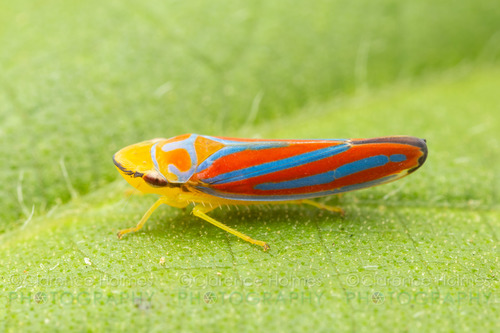
Red-banded Leafhopper
Graphocephala coccinea
Often called the 'Candy-striped Leafhopper,' this tiny insect is one of the most vibrantly colored creatures in North American gardens. With neon-bright stripes and incredible jumping power, it is a favorite for macro photography enthusiasts.
Quick Identification
Size
6.7–8.4 mm (0.26–0.33 inches) in length
Colors
Brilliant diagonal stripes of scarlet-red and turquoise-blue or emerald-green on the wings; head, legs, and thorax are primarily bright yellow with black markings.
Key Features
- Vibrant blue/green and red diagonal wing stripes
- Bright yellow head and underside
- Wedge-shaped 'sharpshooter' body profile
- Powerful jumping hind legs
- Unique sideways 'sidling' movement
When You’ll See Them
Behavior
The Red-banded Leafhopper is a marvel of the insect world, often referred to as a 'sharpshooter.' This nickname comes from their unique method of excreting excess plant sap, which they flick away as tiny droplets known as honeydew. They are highly active during the day, spending their time feeding on the xylem of various host plants. While they are technically solitary, it is common to find several individuals congregating on a single nutrient-rich stem or leaf.
These insects are incredibly wary of movement. When they sense a predator (or a curious gardener), they perform a characteristic 'sidling' maneuver, quickly scuttling to the opposite side of a plant stem to remain out of sight. If further threatened, they use their powerful hind legs to launch themselves into the air with startling speed. Despite their high-energy lifestyle, they are harmless to humans, though they can be minor pests in large numbers due to their sap-sucking habits.
EverydayEarth exclusive
Camera Tips
Capturing the Red-banded Leafhopper requires a different strategy than photographing larger wildlife. Because of their diminutive size, a standard trail camera will struggle to resolve detail. To succeed, you must use a camera with macro capabilities or a dedicated insect-monitoring device placed extremely close to host plants. Focus your efforts on 'hotspot' plants like wild roses, brambles (Rubus species), or rhododendrons. Position your camera about 4 to 8 inches from a cluster of healthy leaves or stems where you have previously spotted movement.
Lighting is your best friend when photographing these vibrant insects. They are most active during bright, sunny days, which allows for higher shutter speeds to freeze their quick movements. If your camera setup allows for an external light source or a small LED panel, use it to fill in shadows and make their neon-like colors pop. Be sure to angle the camera slightly from the side rather than head-on; this highlights the diagonal striping on their wings and their distinct wedge shape.
Because these insects are so sensitive to motion, setting up your camera on a tripod and leaving it to record is the best way to capture natural behavior. Look for the 'sidling' behavior mentioned earlier; you can often trigger this by placing the camera on one side of a stem and then gently waving your hand on the other. If you are using a trigger-based system, set it to the highest sensitivity possible, or use a time-lapse mode that takes a photo every 30 seconds to catch them as they graze across a leaf surface.
In the late summer, look for 'honeydew' droplets on leaves below where they are feeding. This is a clear indicator that the leafhoppers are active above. If you can find a cluster of nymphs (the wingless juveniles), you can document their entire life cycle. The nymphs are often a pale yellow and lack the brilliant stripes of the adults but are just as fascinating to watch under a macro lens.
Similar Species
Species that look similar or are commonly confused with Red-banded Leafhopper.
Frequently Asked Questions
Record Red-banded Leafhopper at your habitat
Connect a camera to start building your own species record — AI identifies every visitor automatically.