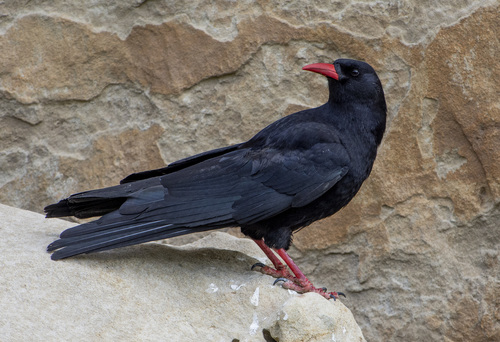
Red-billed Chough
Pyrrhocorax pyrrhocorax
The Red-billed Chough is the high-flying rebel of the corvid family, sporting a vivid red beak and a mastery of the mountain winds. Often found dancing over coastal cliffs, these acrobatic birds are a rare and rewarding sight for any backyard explorer in rugged regions.
Quick Identification
Size
Length 39-40 cm (15-16 in); Wingspan 73-90 cm (29-35 in); Weight 280-360 g (9.8-12.7 oz)
Colors
Glossy velvet-black plumage with a greenish-blue sheen; striking bright red decurved bill; coral-red legs and feet.
Key Features
- Long, slender, downward-curved red bill
- Bright coral-red legs and feet
- Deeply 'fingered' primary feathers visible in flight
- Acrobatic, buoyant flight pattern with fanned tail
When You’ll See Them
Behavior
Red-billed Choughs are the undisputed aerial acrobats of the crow family. Unlike the more common carrion crow, choughs spend their days performing breathtaking displays of dives and rolls, often utilizing the updrafts and thermals found along coastal cliffs and mountain ranges. They are highly social birds, usually seen in pairs or small family groups, though they may form larger flocks for communal roosting during the winter months.
When they aren't in the air, you'll find them meticulously patrolling short-grazed grasslands. They use their specialized curved bills to probe the soil for larvae and insects with surgical precision. While they are naturally wary of humans, they are intensely curious and will often investigate changes in their environment, making them fascinating subjects for those living in their rugged, high-altitude or coastal territories.
EverydayEarth exclusive
Camera Tips
To capture the Red-billed Chough on camera, location is everything. These birds are specialists that rely on short-grazed grass (often maintained by sheep or rabbits) to find food. Position your camera on a low tripod or ground mount facing a patch of well-trodden turf near a cliff edge or rocky outcrop. Because they probe the ground, an upward angle of about 15 degrees from the grass level will help you capture that iconic red bill in action without it being hidden by the terrain.
Lighting is your biggest challenge with black-feathered birds. To avoid the Chough appearing as a featureless black silhouette, set your camera with the sun at your back to illuminate the iridescent sheen of their feathers and the vibrant red of their beak. If your AI camera allows for exposure adjustment, slightly underexposing the shot can help preserve the fine details in their dark plumage that usually get blown out in bright sunlight.
While we don't recommend standard birdseed, you can encourage a visit by providing a shallow, wide stone water basin or even a pile of loose, pesticide-free soil mixed with mealworms. This mimics their natural foraging behavior. Set your camera’s trigger speed to its fastest setting; Choughs are twitchy and fast-moving, and their social interactions involve rapid wing-flicking and head-turning that can easily blur on slower sensors.
During the breeding season (April to June), look for 'fly-ways' where they transit between nesting crevices and feeding grounds. Placing a camera on a prominent rock or fence post that serves as a lookout point can yield incredible 'hero shots' as they land to survey the area. Use a high-quality video mode if possible, as the Chough's vocalizations and social displays are just as captivating as their physical appearance.
Similar Species
Species that look similar or are commonly confused with Red-billed Chough.
Frequently Asked Questions
Record Red-billed Chough at your habitat
Connect a camera to start building your own species record — AI identifies every visitor automatically.