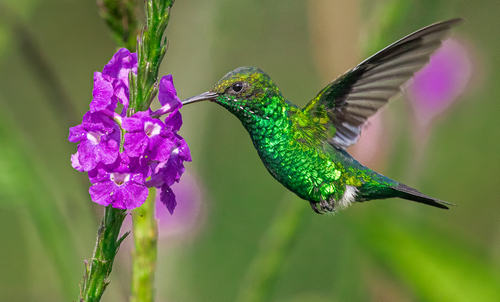
Red-billed Emerald
Chlorostilbon gibsoni
A shimmering jewel of the northern Andes, the Red-billed Emerald is a tiny powerhouse with a vibrant crimson beak and a bold, territorial spirit.
Quick Identification
Size
8-9 cm (3.1-3.5 in) in length; weighs approximately 2.5-4 grams (0.09-0.14 oz)
Colors
Males are glittering golden-green with a bright red bill tipped in black; females have metallic green upperparts with pale grey to white underparts and a dark ear patch.
Key Features
- Bright red bill with a small black tip
- Glittering golden-green plumage in males
- Deeply forked blue-black tail
- White spot behind the eye
When You’ll See Them
Geographic range
Where Does the Red-billed Emerald Live?
Native to the northern reaches of South America, the Red-billed Emerald is a jewel of the dry lowlands and Andean slopes. Its core range spans the arid scrublands and forest edges of northern Colombia and northwestern Venezuela, particularly within the Magdalena and Cauca river valleys. This species thrives in open landscapes, making it a common sight in areas where dense forest gives way to agricultural land or residential gardens.
Basemap © OpenStreetMap contributors
Behavior
The Red-billed Emerald is a highly energetic and territorial hummingbird known for its feisty personality. Despite its small size, it will aggressively defend its favorite nectar sources from much larger birds, using sharp, chattering calls and rapid diving maneuvers to chase intruders away. They are often seen hovering with precision, their wings moving so fast they become a transparent blur, before darting away in a flash of green light.
These birds are mostly solitary outside of the breeding season. They exhibit a 'traplining' foraging strategy, where they follow a regular route to visit specific flowering plants throughout the day. In backyard settings, they quickly become accustomed to human presence, especially if a reliable nectar source is provided, and may even hover close to people to investigate new objects in their territory.
EverydayEarth exclusive
Camera Tips
To capture the Red-billed Emerald on an AI-powered camera, placement is everything. Position your camera approximately 3 to 5 feet away from a hummingbird feeder or a cluster of tubular red or orange flowers. Because these birds are incredibly fast, set your camera to its highest possible frame rate or use a 'burst' photo mode. If your camera supports it, enable 'AI Bird Detection' to ensure the shutter triggers the moment the bird enters the frame.
Lighting is the secret to revealing this bird's true beauty. Hummingbird feathers are iridescent, meaning they rely on light refraction to show color. Position your camera so the sun is behind the lens, shining directly onto the bird's chest. This will make the 'emerald' plumage glow and ensure the red bill is clearly visible. Avoid placing the camera where the bird will be backlit, as this will turn the bird into a dark silhouette.
If you are using a trail camera in a garden, try to mount it at eye level (about 4-5 feet high). Using a small tripod or a flexible clamp on a nearby branch works well. Since Red-billed Emeralds are territorial, if you see one visiting a specific flower, it is highly likely to return to that exact spot every 20-30 minutes, giving you multiple chances to refine your camera settings and capture the perfect shot.
Similar Species
Species that look similar or are commonly confused with Red-billed Emerald.
Blue-tailed Emerald
Has an almost entirely black bill compared to the bright red bill of the Red-billed Emerald.
Glittering-throated Emerald
Lacks the deeply forked tail and has a white patch on the lower belly.
Copper-rumped Hummingbird
Distinguished by its distinct coppery-brown lower back and rump.
Frequently Asked Questions
Record Red-billed Emerald at your habitat
Connect a camera to start building your own species record — AI identifies every visitor automatically.