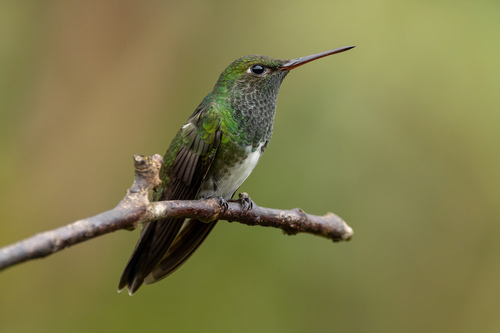
Glittering-throated Emerald
Chionomesa fimbriata
A shimmering jewel of South American gardens, the Glittering-throated Emerald is as bold as it is beautiful. With its iridescent throat and distinctive white-striped belly, it's a high-energy favorite for backyard bird enthusiasts.
Quick Identification
Size
8 to 12 cm (3.1 to 4.7 in) in length; weighs between 3.5 and 6.2 g (0.12 to 0.22 oz)
Colors
Upperparts are shimmering golden-green or bronze-green. Males feature a brilliant glittering green throat and chest; females have white-spotted throats and white-tipped outer tail feathers. Both sexes have a distinct white midline on the belly.
Key Features
- Glittering iridescent green throat and breast
- Distinctive white vertical stripe down the center of the belly
- Straight bill with a pinkish base on the lower mandible
- Blue-black sheen on a slightly forked dark tail
When You’ll See Them
Geographic range
Where Does the Glittering-throated Emerald Live?
The Glittering-throated Emerald is a widespread resident of South America, thriving across the northern and central parts of the continent. Its core range stretches from the Caribbean coasts of Colombia and Venezuela through the Guianas and down into the vast Amazon Basin of Brazil, Peru, and Bolivia. It is also a very common and beloved backyard visitor on the island of Trinidad, though it is generally absent from the high Andes and the far southern cone of the continent.
Basemap © OpenStreetMap contributors
Behavior
Despite their aggressive defense of food sources, these birds are quite comfortable around human habitation. They are inquisitive and may hover just a few feet away from people to investigate bright clothing or new garden fixtures. Their flight is exceptionally agile, allowing them to hover with precision while probing deep into tubular flowers for nectar.
EverydayEarth exclusive
Camera Tips
Set your AI-powered camera to its highest shutter speed or use a dedicated 'Bird' mode if available. These hummingbirds move their wings at incredible speeds, and a fast shutter (at least 1/2000s) is necessary to freeze the action. If you are using a trail camera, ensure it has a fast trigger speed, as these birds often hover for only a few seconds before darting away. High-definition video settings are often better than stills for capturing the shimmering 'glitter' effect as the bird moves its head.
Hummingbirds are creatures of habit. If you notice a Glittering-throated Emerald perching on a specific twig between feedings, move your camera to focus on that branch. This provides a rare opportunity to capture the bird in a resting state, where the white belly stripe and bill details are easier to see. Use a clean, 4:1 water-to-sugar nectar solution to keep them coming back, and try to place your camera in a spot sheltered from heavy wind to keep the feeder stable and the focus sharp.
Similar Species
Species that look similar or are commonly confused with Glittering-throated Emerald.
Frequently Asked Questions
Record Glittering-throated Emerald at your habitat
Connect a camera to start building your own species record — AI identifies every visitor automatically.