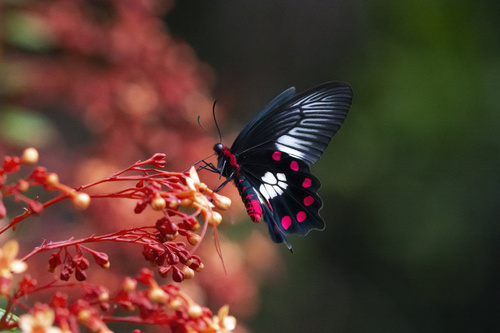
Red-bodied Swallowtail
Pachliopta polydorus
A striking tropical visitor with a bold crimson warning, the Red-bodied Swallowtail floats through northern gardens with effortless grace. Its vibrant colors tell a story of survival, signaling to predators that this beauty is as toxic as it is bright.
Quick Identification
Size
Wingspan of 80–100 mm (3.1–3.9 inches)
Colors
Deep velvety black wings with white patches on the hindwings and distinctive bright red spots; the abdomen is notably bright red or pinkish-red.
Key Features
- Bright red abdomen and thorax
- Large white patches on the center of the hindwings
- Row of red crescent-shaped spots on hindwing margins
- Slow, bobbing flight pattern low to the ground
- Tail-less hindwings unlike many other swallowtails
When You’ll See Them
Geographic range
Where Does the Red-bodied Swallowtail Live?
The Red-bodied Swallowtail is a tropical gem native to the Australasian region. Its primary range encompasses the north-eastern coast of Queensland, Australia, stretching from the Cape York Peninsula down toward Townsville. Beyond the Australian mainland, it is widely distributed across Papua New Guinea, the Solomon Islands, and parts of the Indonesian archipelago, where it thrives in humid, low-elevation environments.
Basemap © OpenStreetMap contributors
Behavior
The Red-bodied Swallowtail is known for its deceptively slow and lazy flight. Unlike many butterflies that dart away at the slightest movement, this species often floats calmly through the air, even in the presence of humans. This confidence stems from its biology; as caterpillars, they consume toxic pipevines (Aristolochia), sequestering chemicals that make the adult butterflies distasteful to birds and other predators. Their bright red body serves as an honest 'aposematic' warning to stay away.
These butterflies are highly active during the middle of the day, particularly when the sun is high. They are frequently seen patrolling the edges of rainforests or visiting suburban gardens to find nectar. While they are generally solitary flyers, several may congregate around a particularly rich nectar source or a flowering tree, creating a stunning display of black and crimson.
EverydayEarth exclusive
Camera Tips
To capture the Red-bodied Swallowtail on a backyard AI camera, placement is everything. Position your camera near 'hotspot' nectar plants such as Ixora, Pentas, or Buddleja. Because these butterflies have a relatively slow, fluttering flight, you don't need the ultra-high shutter speeds required for hummingbirds, but a camera with a fast trigger speed is still essential to catch them as they enter the frame.
For the best results, mount your camera about 3 to 5 feet off the ground, angled slightly downward toward the flowers. This species often feeds on the underside of blooms or hovers at mid-height. If you are specifically looking to capture egg-laying behavior, place the camera near Aristolochia tagala (Dutchman's Pipe) vines, which are their preferred host plant. Ensure the area receives plenty of dappled sunlight, as they are rarely active in deep shade.
Since these insects are most active during the warmest part of the day, set your camera's sensitivity to high during the late morning and early afternoon. Avoid placing the camera in high-wind areas, as the butterflies will seek shelter and stay low to the ground when it's breezy. If your camera supports video, 60fps is ideal for capturing the graceful, rhythmic movement of their wings without motion blur.
Similar Species
Species that look similar or are commonly confused with Red-bodied Swallowtail.
Frequently Asked Questions
Record Red-bodied Swallowtail at your habitat
Connect a camera to start building your own species record — AI identifies every visitor automatically.