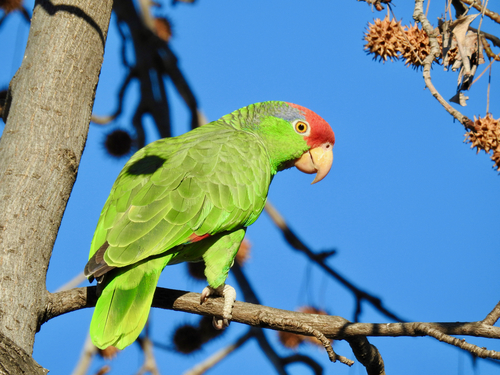
Red-crowned Amazon
Amazona viridigenalis
With its brilliant crimson cap and raucous personality, the Red-crowned Amazon is the charismatic king of the suburban canopy. Once a hidden gem of the Mexican lowlands, these endangered parrots have become iconic residents of urban jungles across the southern United States.
Quick Identification
Size
Length 30-33 cm (12-13 in); wingspan approx. 60-64 cm (24-25 in); weight 270-350g (9.5-12.3 oz)
Colors
Primary emerald green plumage with a brilliant crimson-red crown and forehead. Distinctive lilac-blue streaks behind the eyes and yellowish-green cheeks.
Key Features
- Brilliant red forehead and crown
- Lilac-blue wash behind the eyes and over the nape
- Large, pale horn-colored beak
- Square tail with yellowish-green tips
- Broad wings showing a red speculum patch in flight
When You’ll See Them
Geographic range
Where Does the Red-crowned Amazon Live?
Originally native to the lowland forests and river valleys of northeastern Mexico, particularly the states of Tamaulipas and San Luis Potosí, this parrot now occupies a split range. While its wild population in Mexico has dwindled, robust naturalized populations have flourished in the United States, particularly across the Rio Grande Valley in Texas, Southern California, and parts of Florida. These urban populations often thrive in suburban oases that provide a year-round supply of exotic fruit and nesting sites.
Basemap © OpenStreetMap contributors
Behavior
In suburban environments, these parrots have adapted remarkably well to human presence, often nesting in the cavities of dead palm trees or ornamental hardwoods. They are creatures of habit, following the same flight paths daily and returning to the same roosting sites for years. While they can be wary of direct human approach, they are quite comfortable foraging in backyard fruit trees or visiting bird baths in quiet residential areas.
EverydayEarth exclusive
Camera Tips
To capture the Red-crowned Amazon, aim high. These parrots spend the vast majority of their time in the upper third of the canopy. If you have a second-story balcony or a tall structure, mount your camera there, angled slightly upward toward the crown of a fruiting tree like a Loquat, Pecan, or Date Palm. They are creatures of habit, so if you see them feeding in a specific tree one morning, they are likely to return at the same time the following day.
Baiting with food is often unnecessary if you have a reliable water source. In dry climates like Southern California or South Texas, an elevated bird bath or a 'dripper' fountain is an irresistible magnet. Position your camera 5-10 feet from the water source with a fast shutter speed—at least 1/500s—to freeze their rapid movements and vibrant wing colors. Mid-morning, after their initial feeding frenzy, is the best time for bathing shots.
Because these birds travel in loud groups, use the audio-trigger feature if your camera supports it. The distinctive squawks of a Red-crowned Amazon can trigger the camera before the bird even enters the frame, ensuring you don't miss the approach. For the best lighting, set up your camera to face away from the rising or setting sun; their emerald feathers look most spectacular in 'golden hour' light, which brings out the texture of their plumage.
Similar Species
Species that look similar or are commonly confused with Red-crowned Amazon.
Frequently Asked Questions
Record Red-crowned Amazon at your habitat
Connect a camera to start building your own species record — AI identifies every visitor automatically.