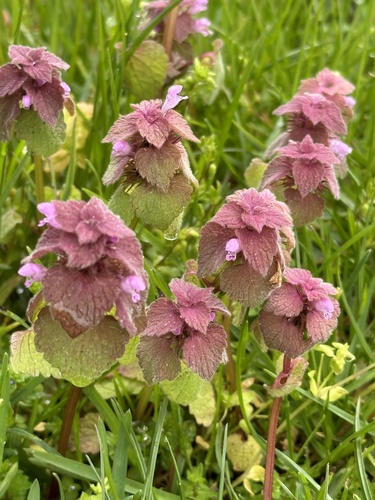
red deadnettle
Lamium purpureum
The early-bird of the backyard world, Red Deadnettle paints the spring landscape in shades of violet and crimson. This friendly 'weed' is a vital lifeline for the first bees of the season.
Quick Identification
Size
Height ranges from 5 to 25 cm (2 to 10 inches); spread can vary as it grows in dense mats.
Colors
Upper leaves are distinctively reddish-purple fading to green at the base; flowers are light pink to deep purple.
Key Features
- Square-shaped stem common to the mint family
- Heart-shaped, fuzzy leaves with serrated edges
- Upper leaves are crowded and transition from green to a vibrant purple-red
- Small, tubular pinkish-purple flowers tucked under leaf layers
When You’ll See Them
Behavior
Red deadnettle is a hardy annual that is often one of the first plants to appear in late winter or early spring. Despite its name, it is not a true nettle and lacks stinging hairs, making it perfectly safe to touch. It grows in low-lying mats, quickly colonizing bare soil or disturbed ground to create a vibrant carpet of purple that provides an essential early-season nectar source for queen bumblebees and other pollinators emerging from hibernation.
As a member of the Lamiaceae (mint) family, it possesses a square stem and grows aggressively through seed dispersal. While many gardeners consider it a weed, it plays a vital role in the backyard ecosystem by stabilizing soil and feeding beneficial insects before most other flowers have bloomed. Its life cycle is relatively short; by the heat of mid-summer, the plant often dies back, leaving behind seeds for the next autumn or spring cycle.
EverydayEarth exclusive
Camera Tips
Because red deadnettle is a stationary plant, the best way to capture it with an AI-powered camera is to focus on the 'action' it attracts. Set your camera on a low tripod or directly on the ground to get a 'bug's eye view' of the flowers. This perspective highlights the unique purple-to-green gradient of the leaves and puts you in the perfect position to capture macro shots of early-season pollinators like mason bees and hoverflies that frequent the blooms.
For the most dramatic footage, use the time-lapse setting over a period of 5-7 days in early spring. You can document the rapid transition of the upper leaves from a muted green to a deep, royal purple. Ensure your camera is positioned to catch the morning light; the fine, downy hairs on the leaves trap dew drops, which sparkle beautifully in the early sun and create high-contrast images that help AI identification software distinguish the leaf texture.
If you are using a motion-activated camera, increase the sensitivity to its highest setting if you want to catch the light vibrations of visiting insects. Alternatively, use a fixed-interval capture mode (every 5 or 10 minutes) to create a growth diary. Avoid placing the camera in deep shade; while the plant can grow there, the colors are much more vivid and the pollinator activity much higher in areas that receive at least partial direct sunlight.
Consider the background when framing your shot. Since red deadnettle grows in dense clusters, try to find a patch at the edge of a path or garden bed. This allows for a cleaner background, making the purple hues of the plant pop against the brown soil or green grass. If your camera allows for manual focus, lock it on the top-most cluster of leaves where the flowers are most likely to emerge.
Similar Species
Species that look similar or are commonly confused with red deadnettle.
Frequently Asked Questions
Record red deadnettle at your habitat
Connect a camera to start building your own species record — AI identifies every visitor automatically.